


 RELEASE DATE
28.04.2026
 VALIDITY PERIOD
01.04.2026 > 30.06.2026
Map
Projected Map
Other Projections


Key
results
Population
estimates
Recommendations
& next steps
Acute
Malnutrition
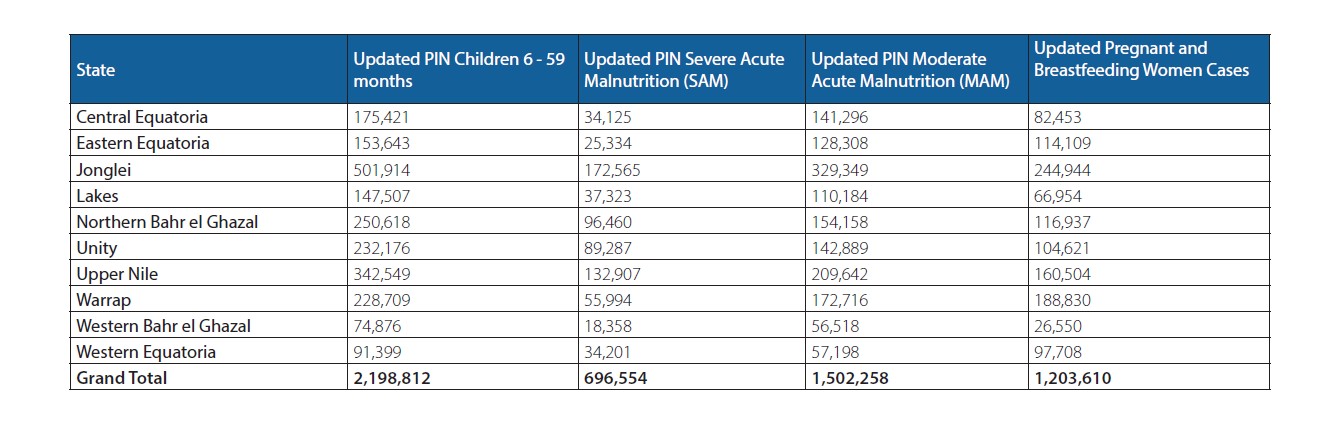
The acute malnutrition situation in South Sudan continues to deteriorate. Similarly to acute food insecurity, this projection update shows an increase in the number of children suffering acute malnutrition from 2.1 million to 2.2 million, representing approximately 90,000 additional cases requiring treatment. Similarly, the number of pregnant and breastfeeding women requiring treatment has increased from 1.1 million to 1.2 million, signalling a growing demand on an already strained health and nutrition system. Out of the 29 analysed areas, 25 counties show deterioration in acute malnutrition, especially in Jonglei, Upper Nile, and Unity states.
A total of 10 counties and the Abyei Administrative Area are classified in IPC Acute Malnutrition (AMN) Phase 5 (Extremely Critical). The counties include Baliet, Akoka, Luakpiny/Nasir and Ulang (Upper Nile), Abiemnhom and Rubkona (Unity), and Duk, Akobo, Fangak and Uror (Jonglei). Compared to the September 2025 IPC AMN projection, multiple counties have deteriorated into more severe phases—notably Akobo, Fangak and Uror (Jonglei), Baliet (Upper Nile), and Abiemnhom (Unity)—while others have worsened within already critical levels of acute malnutrition.
Given the gravity of these conditions, a detailed risk of Famine analysis was conducted in seven counties to assess the likelihood of further deterioration. It determined there is a risk of Famine in Luakpiny/Nasir and Ulang (Upper Nile) and Nyirol and Akobo (Jonglei) under a worst-case scenario involving renewed escalation of conflict, further large-scale displacement, and reduced humanitarian access to highly vulnerable communities. This marks a significant worsening compared with the previous analysis period, when one county was identified as facing a risk of Famine, with the number now rising to four counties. Risks are particularly acute in Akobo, where the potential return of approximately 100,000 South Sudanese currently displaced in Gambela, Ethiopia, could overwhelm already depleted resources and services.
The deterioration in both food security and nutrition is driven by a combination of interlinked factors. Conflict and displacement have disrupted livelihoods, limited access to productive assets, and cut off populations from markets and services. Restricted humanitarian access and insecurity have constrained the delivery of assistance, while prolonged isolation has left some communities without support. Market collapse and rising food prices have reduced household purchasing power, further limiting access to food. At the same time, conflict and flooding have reduced access to medical infrastructure and nutrition services, compounded by severe funding shortages, which have led to a scale down of health and nutrition programmes, supplies, and staff. The nutrition situation is further aggravated by a high and increasing disease burden, including cholera, measles, malaria, diarrhoea, and acute respiratory infections, alongside poor sanitation conditions and limited access to safe water. Disruptions to supply chains due to insecurity have resulted in stockouts of essential nutrition commodities and medical supplies, including preventive services such as vitamin A and deworming.
Country Related Information
Contacts
- 01.04.2026 > 31.07.2026
South Sudan: Acute Food Insecurity Projection Update for April - July 2026 - 01.07.2025 > 30.06.2026
South Sudan: Acute Malnutrition Situation for September - November 2025 and Projections for December 2025 - March 2026 and for April - July 2026 - 01.09.2025 > 31.07.2026
South Sudan: Acute Food Insecurity Situation for September - November 2025 and Projections for December 2025 - March 2026 and for April - July 2026 - 01.04.2025 > 31.07.2025
South Sudan: Acute Malnutrition Situation Projection Update for April - June 2025 - 01.04.2025 > 31.07.2025
South Sudan: Acute Food Insecurity Situation Projection Update for April - July 2025 - 01.07.2024 > 30.06.2025
South Sudan: Acute Malnutrition Situation for July - September 2024 and Projections for October 2024 - March 2025 and April- June 2025 - 01.09.2024 > 30.06.2025
South Sudan: Acute Food Insecurity Situation for September - November 2024 and Projections for December 2024 - March 2025 and for April - July 2025 - 01.07.2023 > 30.06.2024
South Sudan: Acute Malnutrition Situation for July - September 2023 and Projections for October 2023 - March 2024 and April- June 2024 - 01.09.2023 > 31.07.2024
South Sudan: Acute Food Insecurity Situation for September - November 2023 and Projections for December 2023 - March 2024 and for April - July 2024 - 01.07.2022 > 30.06.2023
South Sudan: Acute Malnutrition Situation July - October 2022 and Projections for November 2022 - February 2023 and March - June 2023 - 01.10.2022 > 31.07.2023
South Sudan: Acute Food Insecurity Situation October - November 2022 and Projections for December 2022 - March 2023 and April - July 2023 - 01.02.2022 > 31.07.2022
South Sudan: Acute Malnutrition Situation for February - March 2022 and Projections for April - July 2022 - 01.02.2022 > 31.07.2022
South Sudan: Acute Food Insecurity and Acute Malnutrition Situation for February - March 2022 and Projections for April - July 2022 - 01.10.2020 > 31.07.2021
South Sudan: Acute Food Insecurity Situation for October - November 2020 and Projections for December 2020 - March 2021 and April - July 2021 - 01.01.2020 > 31.07.2020
South Sudan: Acute Food Insecurity Situation January 2020 and Projections for February - April 2020 and May - July 2020 - 01.01.2020 > 31.08.2020
South Sudan: Acute Malnutrition Situation January - April 2020 and Projection for May - August 2020 - 01.08.2019 > 30.04.2020
South Sudan: Acute Food Insecurity Situation for August 2019 and Projection for September - December 2019 and January - April 2020 - 01.08.2019 > 31.12.2019
South Sudan: Acute Malnutrition Situation for August 2019 and Projection for September - December 2019 - 01.05.2019 > 31.07.2019
South Sudan: Acute Food Insecurity Projection Update for May - July 2019 - 01.01.2019 > 31.07.2019
South Sudan: Acute Food Insecurity Situation January 2019 and Projections for February - April 2019 and May - July 2019 - 01.01.2019 > 31.08.2019
South Sudan: Acute Malnutrition Situation January - April 2019 and Projection for May - July 2019 - 01.09.2018 > 31.12.2018
South Sudan: Acute Malnutrition Situation September 2018 and Projection for October - December 2018 - 01.09.2018 > 31.03.2019
South Sudan: Acute Food Insecurity Situation in September 2018 and Projections for October-December 2018 and January-March 2019 - 01.01.2018 > 31.07.2018
South Sudan: Acute Malnutrition Situation in January 2018 and Projections for February-April 2018 and May-July 2018 - 01.01.2018 > 31.07.2018
South Sudan: Acute Food Insecurity Situation in January 2018 and Projections for February-April 2018 and May-July 2018 - 01.09.2017 > 31.12.2017
South Sudan: Acute Malnutrition Situation September 2017 and Projection for October - December 2017 - 01.09.2017 > 31.03.2018
South Sudan: Acute Food Insecurity Situation September 2017 and Projection for October - December 2017 and January - March 2018 - 01.05.2017 > 31.07.2017
South Sudan: Acute Malnutrition Situation for May 2017 and Projection for June - July 2017 - 01.05.2017 > 31.07.2017
South Sudan: Acute Food Insecurity Situation for May 2017 and Projection for June - July 2017 - 01.01.2017 > 31.07.2017
South Sudan: Acute Food Insecurity Situation for January 2017 and Projections for February - April 2017 and May - July 2017 - 01.09.2016 > 31.07.2017
South Sudan: Acute Malnutrition Situation for September 2016 - January 2017 and Projections for February - April 2017 and May - July 2017 - 01.08.2016 > 31.12.2016
South Sudan: Acute Malnutrition Situation August 2016 and Projection for September - December 2016 - 01.08.2016 > 31.12.2016
South Sudan: Acute Food Insecurity Situation August - September 2016 and Projection for October - December 2016 - 01.04.2016 > 31.07.2016
South Sudan: Acute Food Insecurity Situation in April 2016 and Projection for May-July 2016 - 01.01.2016 > 31.07.2016
South Sudan: Acute Malnutrition Situation January - April 2016 and Projection for May-July 2016 - 30.04.2015 > 30.09.2015
South Sudan: Acute Food Insecurity Situation in April 2015 and Projections for May - July 2015 and August - September 2015 - 01.09.2015 > 31.12.2015
South Sudan: Acute Food Insecurity Situation August-September 2015 and Projections for October - December 2015 and January-March 2016 - 01.01.2015 > 31.03.2015
South Sudan: Update of Acute Food Security Situation Projection for January - March 2015 - 01.09.2014 > 31.03.2015
South Sudan: Acute Food Insecurity Situation September 2014 and Projections for October - December 2014 and January - March 2015 - 01.05.2014 > 30.08.2014
South Sudan: Acute Food Insecurity Situation in May 2014 and Projection for June - August 2014 - 01.01.2014 > 31.01.2014
South Sudan: Acute Food Insecurity Situation in January 2014 - 30.07.2013 > 30.10.2013
South Sudan: Acute Food Insecurity Situation July - August 2013 and Projection for July - October 2013 - 18.11.2012 > 18.03.2013
South Sudan: Acute Food Insecurity Situation in November 2012 and Projection for November 2012 - March 2013 - 25.08.2012 > 30.11.2012
South Sudan: Acute Food Insecurity Situation August 2012 and Projection for August - November 2012 - 01.04.2012 > 20.07.2012
South Sudan: Acute Food Insecurity Situation April 2012 and Projection for April-July 2012 - 09.12.2011 > 31.03.2012
South Sudan: Acute Food Insecurity Situation December 2011 and Projection for December 2011 - March 2012
- 23.03.2026 > 06.04.2026
South Sudan: Acute Food Insecurity Analysis (TBC) - 22.09.2025 > 04.10.2025
South Sudan: Acute Food Insecurity and Acute Malnutrition Analyses - 22.04.2025 > 06.05.2025
South Sudan: Acute Food Insecurity and Acute Malnutrition Analyses (Update) - 25.09.2024 > 05.10.2024
South Sudan: Acute Food Insecurity and Acute Malnutrition Analyses

Join our mailing list