


 RELEASE DATE
21.02.2019
 VALIDITY PERIOD
01.01.2019 > 31.08.2019
Map
Projected Map
Other Projections


Key
results
Population
estimates
Recommendations
& next steps
Acute
Malnutrition
DISCLAIMER: please note that this IPC Acute Malnutrition analysis was integrated with an IPC Acute Food Insecurity analysis referring to the same period. Please click here.
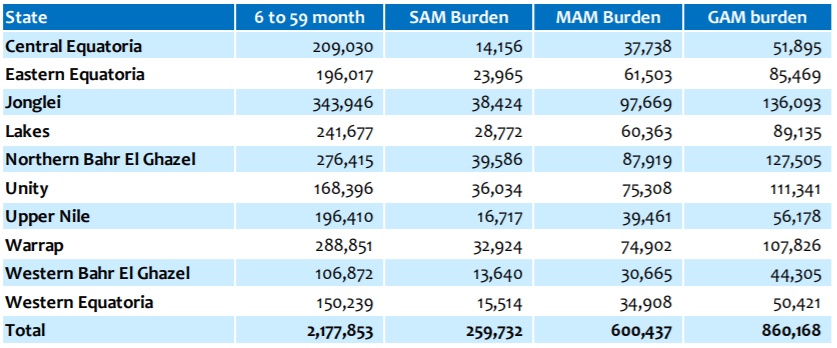
How Severe, How Many and When – A total of 860, 000 children are likely to suffer from acute malnutrition in 2019 based on the results of the SMART nutrition surveys, Food Security and Nutrition Monitoring System (FSNMS) and admission trends for 2018.
Where – 42 counties are classified as Serious (IPC Acute Malnutrition Phase 3) and above. The counties of Akobo, Ayod, Canal Pigi, Pibor, Duk, Uror (former Jonglei); Abiemnhom, Panyijar and Pariang (former Unity); Twic (former Warrap); and Awerial (former Lakes) are classified as Critical (IPC Acute Malnutrition Phase 4). No county was classified as Extremely Critical (IPC Acute Malnutrition Phase 5). However, further deterioration is expected in the projection period (lean season) of May-August 2019 with more than 55 counties classified as Serious 4 (IPC Acute Malnutrition Phase 3) and above, therefore requiring urgent and targeted response.
Why – The major factors contributing to acute malnutrition include insufficient availability of food, very poor quality and diversity of food, relatively high prevalence of diseases6 and poor child care practices. Elevated level of food insecurity (IPC AFI phase 3 and above) in some counties also contribute to acute malnutrition. Additionally, reduced access to food, nutrition and health services linked to conflict including inter communal conflict in some counties is also aggravating the levels of acute malnutrition.
Country Related Information
Contacts
- 01.04.2026 > 30.06.2026
South Sudan: Acute Malnutrition Projection Update for April - June 2026 - 01.04.2026 > 31.07.2026
South Sudan: Acute Food Insecurity Projection Update for April - July 2026 - 01.07.2025 > 30.06.2026
South Sudan: Acute Malnutrition Situation for September - November 2025 and Projections for December 2025 - March 2026 and for April - July 2026 - 01.09.2025 > 31.07.2026
South Sudan: Acute Food Insecurity Situation for September - November 2025 and Projections for December 2025 - March 2026 and for April - July 2026 - 01.04.2025 > 31.07.2025
South Sudan: Acute Malnutrition Situation Projection Update for April - June 2025 - 01.04.2025 > 31.07.2025
South Sudan: Acute Food Insecurity Situation Projection Update for April - July 2025 - 01.07.2024 > 30.06.2025
South Sudan: Acute Malnutrition Situation for July - September 2024 and Projections for October 2024 - March 2025 and April- June 2025 - 01.09.2024 > 30.06.2025
South Sudan: Acute Food Insecurity Situation for September - November 2024 and Projections for December 2024 - March 2025 and for April - July 2025 - 01.07.2023 > 30.06.2024
South Sudan: Acute Malnutrition Situation for July - September 2023 and Projections for October 2023 - March 2024 and April- June 2024 - 01.09.2023 > 31.07.2024
South Sudan: Acute Food Insecurity Situation for September - November 2023 and Projections for December 2023 - March 2024 and for April - July 2024 - 01.07.2022 > 30.06.2023
South Sudan: Acute Malnutrition Situation July - October 2022 and Projections for November 2022 - February 2023 and March - June 2023 - 01.10.2022 > 31.07.2023
South Sudan: Acute Food Insecurity Situation October - November 2022 and Projections for December 2022 - March 2023 and April - July 2023 - 01.02.2022 > 31.07.2022
South Sudan: Acute Malnutrition Situation for February - March 2022 and Projections for April - July 2022 - 01.02.2022 > 31.07.2022
South Sudan: Acute Food Insecurity and Acute Malnutrition Situation for February - March 2022 and Projections for April - July 2022 - 01.10.2020 > 31.07.2021
South Sudan: Acute Food Insecurity Situation for October - November 2020 and Projections for December 2020 - March 2021 and April - July 2021 - 01.01.2020 > 31.07.2020
South Sudan: Acute Food Insecurity Situation January 2020 and Projections for February - April 2020 and May - July 2020 - 01.01.2020 > 31.08.2020
South Sudan: Acute Malnutrition Situation January - April 2020 and Projection for May - August 2020 - 01.08.2019 > 30.04.2020
South Sudan: Acute Food Insecurity Situation for August 2019 and Projection for September - December 2019 and January - April 2020 - 01.08.2019 > 31.12.2019
South Sudan: Acute Malnutrition Situation for August 2019 and Projection for September - December 2019 - 01.05.2019 > 31.07.2019
South Sudan: Acute Food Insecurity Projection Update for May - July 2019 - 01.01.2019 > 31.07.2019
South Sudan: Acute Food Insecurity Situation January 2019 and Projections for February - April 2019 and May - July 2019 - 01.09.2018 > 31.12.2018
South Sudan: Acute Malnutrition Situation September 2018 and Projection for October - December 2018 - 01.09.2018 > 31.03.2019
South Sudan: Acute Food Insecurity Situation in September 2018 and Projections for October-December 2018 and January-March 2019 - 01.01.2018 > 31.07.2018
South Sudan: Acute Malnutrition Situation in January 2018 and Projections for February-April 2018 and May-July 2018 - 01.01.2018 > 31.07.2018
South Sudan: Acute Food Insecurity Situation in January 2018 and Projections for February-April 2018 and May-July 2018 - 01.09.2017 > 31.12.2017
South Sudan: Acute Malnutrition Situation September 2017 and Projection for October - December 2017 - 01.09.2017 > 31.03.2018
South Sudan: Acute Food Insecurity Situation September 2017 and Projection for October - December 2017 and January - March 2018 - 01.05.2017 > 31.07.2017
South Sudan: Acute Malnutrition Situation for May 2017 and Projection for June - July 2017 - 01.05.2017 > 31.07.2017
South Sudan: Acute Food Insecurity Situation for May 2017 and Projection for June - July 2017 - 01.01.2017 > 31.07.2017
South Sudan: Acute Food Insecurity Situation for January 2017 and Projections for February - April 2017 and May - July 2017 - 01.09.2016 > 31.07.2017
South Sudan: Acute Malnutrition Situation for September 2016 - January 2017 and Projections for February - April 2017 and May - July 2017 - 01.08.2016 > 31.12.2016
South Sudan: Acute Malnutrition Situation August 2016 and Projection for September - December 2016 - 01.08.2016 > 31.12.2016
South Sudan: Acute Food Insecurity Situation August - September 2016 and Projection for October - December 2016 - 01.04.2016 > 31.07.2016
South Sudan: Acute Food Insecurity Situation in April 2016 and Projection for May-July 2016 - 01.01.2016 > 31.07.2016
South Sudan: Acute Malnutrition Situation January - April 2016 and Projection for May-July 2016 - 30.04.2015 > 30.09.2015
South Sudan: Acute Food Insecurity Situation in April 2015 and Projections for May - July 2015 and August - September 2015 - 01.09.2015 > 31.12.2015
South Sudan: Acute Food Insecurity Situation August-September 2015 and Projections for October - December 2015 and January-March 2016 - 01.01.2015 > 31.03.2015
South Sudan: Update of Acute Food Security Situation Projection for January - March 2015 - 01.09.2014 > 31.03.2015
South Sudan: Acute Food Insecurity Situation September 2014 and Projections for October - December 2014 and January - March 2015 - 01.05.2014 > 30.08.2014
South Sudan: Acute Food Insecurity Situation in May 2014 and Projection for June - August 2014 - 01.01.2014 > 31.01.2014
South Sudan: Acute Food Insecurity Situation in January 2014 - 30.07.2013 > 30.10.2013
South Sudan: Acute Food Insecurity Situation July - August 2013 and Projection for July - October 2013 - 18.11.2012 > 18.03.2013
South Sudan: Acute Food Insecurity Situation in November 2012 and Projection for November 2012 - March 2013 - 25.08.2012 > 30.11.2012
South Sudan: Acute Food Insecurity Situation August 2012 and Projection for August - November 2012 - 01.04.2012 > 20.07.2012
South Sudan: Acute Food Insecurity Situation April 2012 and Projection for April-July 2012 - 09.12.2011 > 31.03.2012
South Sudan: Acute Food Insecurity Situation December 2011 and Projection for December 2011 - March 2012
- 23.03.2026 > 06.04.2026
South Sudan: Acute Food Insecurity Analysis (TBC) - 22.09.2025 > 04.10.2025
South Sudan: Acute Food Insecurity and Acute Malnutrition Analyses - 22.04.2025 > 06.05.2025
South Sudan: Acute Food Insecurity and Acute Malnutrition Analyses (Update) - 25.09.2024 > 05.10.2024
South Sudan: Acute Food Insecurity and Acute Malnutrition Analyses

Join our mailing list