


 RELEASE DATE
16.09.2025
 VALIDITY PERIOD
01.04.2025 > 31.03.2026
Map
Projected Map
Other Projections


Key
results
Population
estimates
Recommendations
& next steps
Acute
Malnutrition
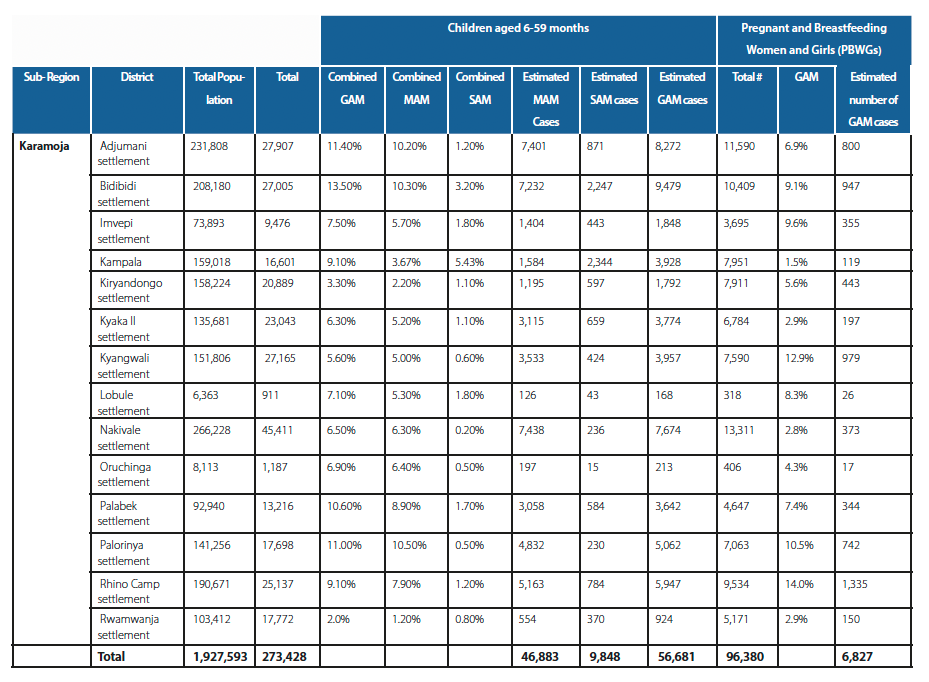
The IPC Acute Malnutrition (AMN) analysis of Uganda’s refugee settlements and Kampala’s urban refugees found that approximately 56,681 children aged 6–59 months and 6,827 pregnant or breastfeeding women (PBW) are suffering or projected to suffer from acute malnutrition between April 2025 and March 2026. The situation between April and September 2025 was significantly worse compared to the same period in 2024.
Three refugee settlements—Adjumani, Bidibidi, and Palorinya—were classified in IPC AMN Phase 3 (Serious). Six settlements (Imvepi, Kiryandongo, Lobule, Oruchiga, Palabek, and Rhino Camp) along with Kampala’s urban refugees were classified in IPC AMN Phase 2 (Alert). The remaining four settlements—Kyaka II, Kyangwali, Nakivale, and Rwamwanja—were classified in IPC AMN Phase 1 (Acceptable).
The high prevalence of acute malnutrition is linked to multiple factors, including high disease burden, suboptimal child feeding practices, an influx of new refugee arrivals that strain existing resources, limited household access to food, and reduced humanitarian support that has constrained food aid coverage, led to closure of nutrition sites, and curtailed outreach programs.
Looking ahead, acute malnutrition is expected to improve between October 2025 and March 2026 across 11 refugee settlements, with the exception of Oruchiga and Nakivale (both in Isingiro District), where deterioration is projected. Notably, the three settlements currently in Phase 3 (Serious)—Adjumani, Bidibidi, and Palorinya—are expected to improve to Phase 2 (Alert). This anticipated improvement is largely attributed to the main harvests, which are expected to boost food availability in markets and reduce prices.
Country Related Information
Contacts
- 01.08.2026 > 28.02.2027
Uganda: Acute Malnutrition Situation for April–September 2026 and Projection for October 2026–March 2027 - 01.08.2026 > 28.02.2027
Uganda: Acute Food Insecurity Situation July 2026–January 2027 and Projection for February–June 2027* - 01.03.2026 > 28.02.2027
Uganda (Karamoja): Acute Malnutrition Situation for March - August 2026 and Projection for September 2026 - February 2027 - 01.04.2026 > 28.02.2027
Uganda (Karamoja): Acute Food Insecurity Situation for April - July 2026 and Projection for August 2026 - February 2027 - 01.04.2025 > 31.03.2026
Uganda Refugees: Acute Food Insecurity Situation April - July 2025 and Projection for August 2025 - February 2026 - 01.04.2025 > 31.03.2026
Uganda: Acute Malnutrition Situation April - September 2025 and Projection for October 2025 - March 2026 - 01.06.2025 > 28.02.2026
Uganda: Acute Food Insecurity Situation June - July 2025 and Projection for August 2025 - February 2026 - 01.04.2024 > 31.03.2025
Uganda: Acute Malnutrition Situation April - September 2024 and Projection for October 2024 - March 2025 - 01.07.2024 > 30.06.2025
Uganda: Acute Food Insecurity Situation July 2024 - January 2025 and Projection for February - June 2025 - 01.03.2024 > 28.02.2025
Uganda: Acute Malnutrition Situation March - May 2024 and Projections for June - October 2024 and November 2024 - February 2025 - 01.03.2024 > 28.02.2025
Uganda: Acute Food Insecurity Situation March - July 2024 and Projection for August 2024 - February 2025 - 01.04.2023 > 31.03.2024
Uganda: Acute Malnutrition Situation April - September 2023 and Projection for October 2023 - March 2024 - 01.08.2023 > 30.06.2024
Uganda: Acute Food Insecurity Situation August 2023 - January 2024 and Projection for February - June 2024 - 01.02.2023 > 15.06.2023
Uganda: Acute Malnutrition Situation February - April 2023 and Projections for May - September 2023 and October 2023 - January 2024 - 01.04.2023 > 28.02.2024
Uganda: Acute Food Insecurity Situation April - August 2023 and Projection for September 2023 - February 2024 - 01.02.2022 > 31.01.2023
Uganda: Acute Malnutrition Situation February - July 2022 and Projection for August 2022 - January 2023 - 01.06.2022 > 31.01.2023
Uganda: Acute Food Insecurity Situation June - August 2022 and Projection for September 2022 - January 2023 - 01.02.2022 > 31.01.2023
Uganda (Karamoja): Acute Malnutrition Situation February - July 2022 and Projection for August - January 2023 - 01.03.2022 > 28.02.2023
Uganda (Karamoja): Acute Food Insecurity Situation March - July 2022 and Projection for August 2022 - February 2023 - 01.02.2021 > 31.01.2022
Uganda: Acute Food Insecurity Situation March - July 2021 and August 2021 - January 2022 (Karamoja) - 01.11.2020 > 30.09.2021
Uganda: Acute Malnutrition Situation November 2020 - April 2021 and Projection for May - September 2021 (Refugee settlements) - 01.02.2021 > 31.01.2022
Uganda: Acute Malnutrition Situation February - July 2021 and Projection for August 2021 - January 2022 (Karamoja) - 01.06.2020 > 31.01.2021
Uganda: Acute Food Insecurity Situation June - August 2020 and Projection for September 2020 - January 2021 and Acute Malnutrition Situation February 2020 - January 2021 - 01.05.2019 > 30.04.2020
Uganda: Acute Malnutrition Situation May - October 2019 and Projection for November 2019 - April 2020 (Northern Region) - 01.10.2018 > 31.03.2019
Uganda: Acute Food Insecurity Situation October - December 2018 and Projection January - March 2019 - 01.11.2017 > 28.02.2018
Uganda: Acute Food Insecurity Situation for November 2017 - February 2018 - 27.01.2017 > 31.03.2017
Uganda: Acute Food Insecurity Situation January-March 2017 - 01.09.2016 > 30.11.2016
Uganda: Acute Food Insecurity Situation September - November 2016 - 01.11.2015 > 30.04.2016
Uganda: Acute Food Insecurity Situation November 2015 - April 2016 - 22.06.2015 > 01.11.2015
Uganda: Acute Food Insecurity Situation in Karamoja Region for June - November 2015 - 01.02.2015 > 29.02.2020
Uganda: Chronic Food Insecurity Situation, February 2015-2018/20 - 01.09.2014 > 31.12.2014
Uganda: Acute Food Insecurity Situation September - December 2014 - 01.11.2013 > 30.11.2013
Uganda: Acute Food Insecurity Situation November 2013 - 01.06.2013 > 30.09.2013
Uganda: Acute Food Insecurity Situation in June - September 2013 - 16.02.2013 > 28.02.2013
Uganda: Acute Food Insecurity Situation in Karamoja Region February 2013
- 25.08.2026 > 29.08.2026
Uganda (refugees & other areas): Acute Food Insecurity and Acute Malnutrition Analyses - 18.08.2026 > 23.08.2026
Uganda (Karamoja): Acute Food Insecurity and Acute Malnutrition Analyses - 20.04.2026 > 24.04.2026
Uganda: Acute Food Insecurity and Acute Malnutrition Analyses - 22.06.2025 > 02.07.2025
Uganda: Acute Food Insecurity and Malnutrition Analyses

Join our mailing list