


 RELEASE DATE
17.04.2026
 VALIDITY PERIOD
01.10.2025 > 30.09.2026
Map
Projected Map
Other Projections


Key
results
Population
estimates
Recommendations
& next steps
Acute
Malnutrition
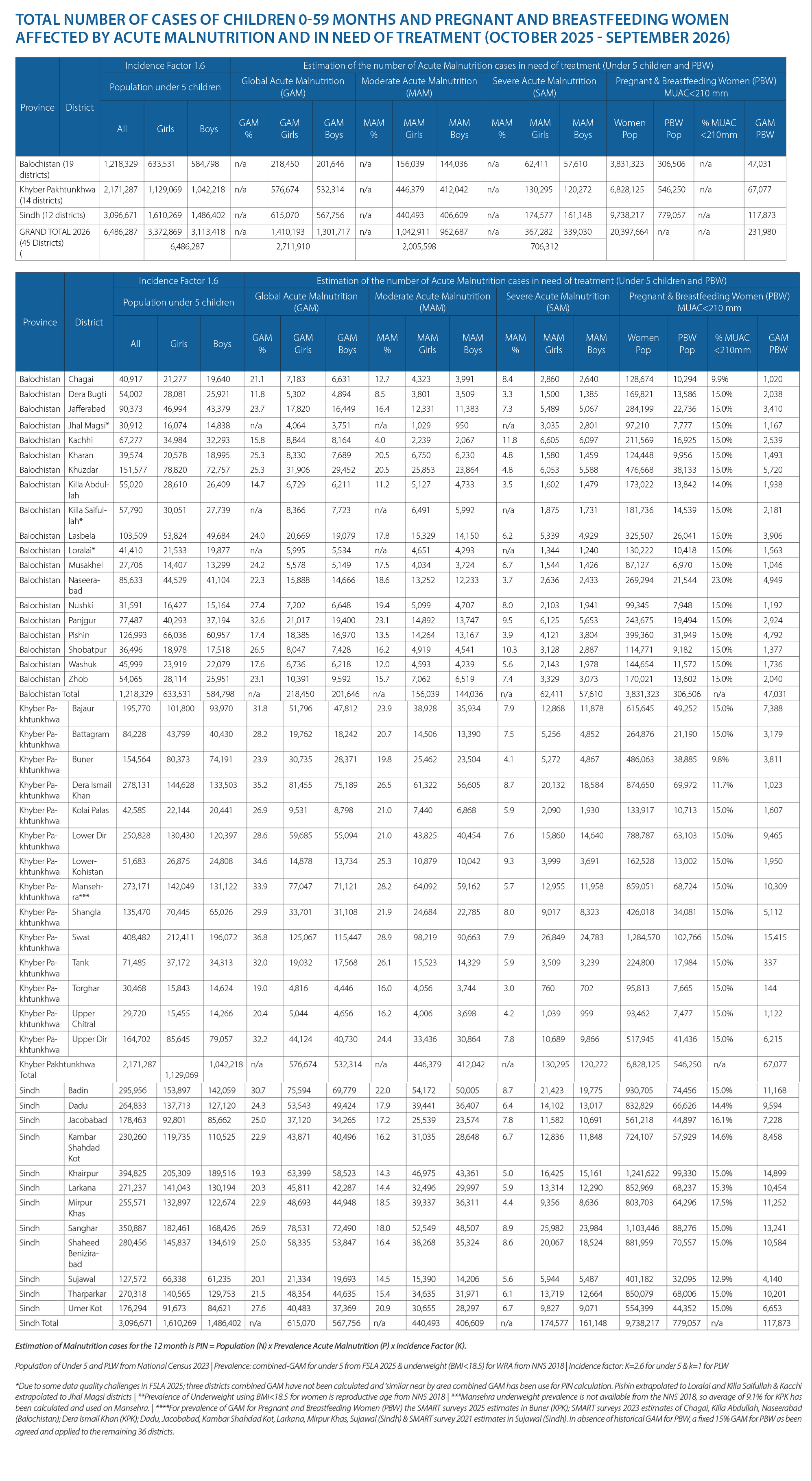
Rates of acute malnutrition for vulnerable populations are concerning across 45 rural districts in Pakistan’s Balochistan, Khyber Pakhtunkhwa and Sindh provinces. The situation is driven primarily by seasonal diseases, inadequate feeding and caring practices, poor child dietary diversity, limited access to health services and recurrent natural shocks.
Over 2.71 million cases of children aged 6-59 months are currently suffering from acute malnutrition—conditions expected to persist through September 2026. This includes around 706,000 will be cases of children suffering from severe acute malnutrition (SAM) at risk of death and around 2 million children suffering from moderate acute malnutrition (MAM). Around 232,000 cases of pregnant and breastfeeding women (PBW) suffering from acute malnutrition are expected during the same period. Sindh Province records the highest number of malnourished children with 1.18 million (44 percent of the total population), followed by Khyber Pakhtunkhwa with 1.11 million (41 percent) and Balochistan with 420,000 (15 percent).
There are currently 28 districts (out of the 45 analysed) classified in IPC AMN Phase 4 (Critical). In these areas, acute malnutrition among children is characterised by widespread wasting, as well as death from preventable diseases. Urgent response actions are needed, including supplementary feeding in the most affected areas to protect children and PBW from acute malnutrition. The Sindh province presents the most critical situation with 11 out of 12 districts classified in Phase 4. In Khyber Pakhtunkhwa, 10 out of 14 districts are in Phase 4, while in Balochistan, 7 out of 19 districts are in Phase 4.
During the projected period (April–September 2026), a slight improvement in the nutrition situation is expected, particularly in districts affected by harsh winters and limited access to health services in the current period.
Country Related Information
Contacts
- 01.12.2025 > 30.09.2026
Pakistan: Acute Food Insecurity Situation for December 2025–March 2026 and Projection for April–September 2026 - 01.11.2024 > 31.07.2025
Pakistan: Acute Food Insecurity Situation for November 2024 - March 2025 and Projection for April - July 2025 - 01.03.2024 > 30.11.2024
Pakistan: Acute Food Insecurity Situation for March - June 2024 and Projection for July - November 2024 - 01.03.2023 > 31.01.2024
Pakistan: Acute Malnutrition Situation for March - September 2023 and Projection for October 2023 - January 2024 - 01.04.2023 > 31.01.2024
Pakistan: Acute Food Insecurity Situation for April - October 2023 and Projection for November 2023 - January 2024 - 01.07.2022 > 31.12.2022
Pakistan: Acute Food Insecurity Situation July - August 2022 and Projection for September - December 2022 - 01.10.2021 > 30.06.2022
Pakistan: Acute Food Insecurity Situation October 2021 - March/April 2022 and Projection for April/May - June 2022 - 01.04.2021 > 28.02.2022
Pakistan: Acute Malnutrition Situation in Sindh April - November 2021 and December 2021 - February 2022 - 01.03.2021 > 30.09.2021
Pakistan: Acute Food Insecurity Situation March - June 2021 and Projection for July - September 2021 in Balochistan and Sindh - 01.01.2020 > 31.08.2020
Pakistan: Acute Food Insecurity in Khyber Pakhtunkhwa January to May 2020 and Projection for June to August 2020 - 01.05.2019 > 31.12.2019
Pakistan: Acute Malnutrition in Sindh May - August 2019 and Projection for September - December 2019 - 01.05.2019 > 30.11.2020
Pakistan: Acute Malnutrition in Balochistan May - August 2019 and Projection for September - November 2019 - 01.10.2018 > 30.11.2019
Pakistan: Acute Food Insecurity in Balochistan January - July 2019 and Projection for July - November 2019 and Sindh October 2018 - July 2019 and Projection for July - October 2019 - 01.04.2017 > 30.09.2017
Pakistan: Acute Malnutrition Situation April-June 2017 and Projection for July-September 2017 - 01.02.2017 > 04.08.2017
Pakistan: Acute Food Insecurity in Sindh Province February - August 2017 - 08.10.2014 > 18.12.2014
Pakistan: Acute Food Insecurity Situation October - December 2014 - 03.03.2013 > 31.03.2013
Pakistan: Acute Food Security Situation March 2013
- 31.01.2026 > 04.02.2026
Pakistan: Acute Food Insecurity and Acute Malnutrition Analyses - 11.12.2025 > 19.12.2025
Pakistan: Acute Food Insecurity & Acute Malnutrition Analysis - 14.11.2024 > 21.11.2024
Pakistan: Acute Food Insecurity Analysis - 04.03.2024 > 09.03.2024
Pakistan: Acute Food Insecurity Analysis

Join our mailing list