


 RELEASE DATE
07.09.2026
 VALIDITY PERIOD
01.08.2026 > 28.02.2027
Map
Projected Map
Other Projections


Key
results
Population
estimates
Recommendations
& next steps
Acute
Malnutrition
Across much of Uganda, El Niño-induced dry spells led to extreme crop and pasture losses, which, alongside rising food prices, has greatly reduced food affordability and access. This is driving high levels of acute food insecurity and malnutrition in the Karamoja region and among vulnerable populations, including refugees and host communities, in other parts of the country. Low crop and livestock production, limited income, and high prices are reducing purchasing power and increasing households’ reliance on markets and external food assistance. Limited income opportunities and localised conflicts, particularly in Karamoja, also restrict food access. At the same time, reduced humanitarian assistance levels are diminishing vulnerable households’ capacity to cope with these conditions.
Two recent IPC analyses from August 2026 covered 60 areas across Uganda, including nine Karamoja districts,12 refugee-hosting districts, 13 refugee settlements, urban refugees in Kampala, and 25 additional districts.
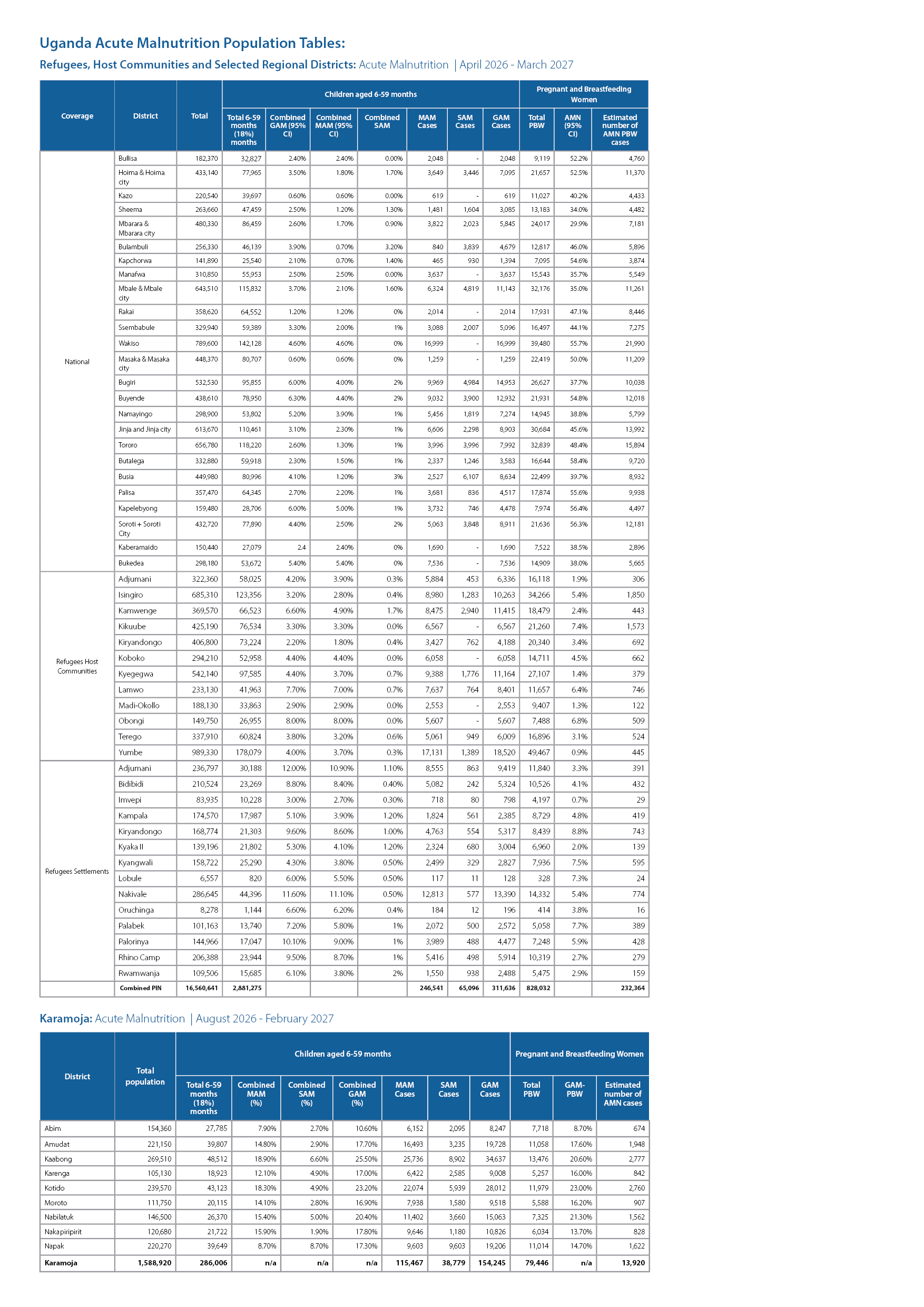
Acute food insecurity and high morbidity to diseases are driving acute malnutrition among vulnerable populations, with a notable deterioration in Karamoja. From April 2026–March 2027, approximately 465,900 children aged 6–59 months and 246,300 pregnant and breastfeeding women are suffering or expected to suffer from acute malnutrition and need treatment. This includes 58,200 children in refugee settlements, 97,100 in host communities and 156,300 in other vulnerable areas, as well as 154,200 children in Karamoja, which accounts for 33 percent of the overall malnourished children in the analysed population.
During the current period from April to September 2026,* Kotido and Kaabong (Karamoja) are classified in IPC Acute Malnutrition (AMN) Phase 4 (Critical), while Amudat, Moroto, Nabilatuk and Nakapiripirit (Karamoja) and Adjumani refugee settlement are classified in IPC AMN Phase 3 (Serious). In the projection period from October 2026 to March 2027,** acute malnutrition is expected to deteriorate in the refugee settlements and Karamoja, as food insecurity worsens due to total crop failure in Karamoja and failed second season harvests in refugee-hosting districts. Flash floods and El Niño-induced above-average rains will heighten the risk of disease outbreaks.
*For Karamoja, the current period is August–October 2026.
**For Karamoja, the projected period is November 2026–February 2027.
Country Related Information
Contacts
- 01.08.2026 > 28.02.2027
Uganda: Acute Food Insecurity Situation July 2026–January 2027 and Projection for February–June 2027* - 01.03.2026 > 28.02.2027
Uganda (Karamoja): Acute Malnutrition Situation for March - August 2026 and Projection for September 2026 - February 2027 - 01.04.2026 > 28.02.2027
Uganda (Karamoja): Acute Food Insecurity Situation for April - July 2026 and Projection for August 2026 - February 2027 - 01.04.2025 > 31.03.2026
Uganda Refugees: Acute Malnutrition Situation April - September 2025 and Projection for October 2025 - March 2026 - 01.04.2025 > 31.03.2026
Uganda Refugees: Acute Food Insecurity Situation April - July 2025 and Projection for August 2025 - February 2026 - 01.04.2025 > 31.03.2026
Uganda: Acute Malnutrition Situation April - September 2025 and Projection for October 2025 - March 2026 - 01.06.2025 > 28.02.2026
Uganda: Acute Food Insecurity Situation June - July 2025 and Projection for August 2025 - February 2026 - 01.04.2024 > 31.03.2025
Uganda: Acute Malnutrition Situation April - September 2024 and Projection for October 2024 - March 2025 - 01.07.2024 > 30.06.2025
Uganda: Acute Food Insecurity Situation July 2024 - January 2025 and Projection for February - June 2025 - 01.03.2024 > 28.02.2025
Uganda: Acute Malnutrition Situation March - May 2024 and Projections for June - October 2024 and November 2024 - February 2025 - 01.03.2024 > 28.02.2025
Uganda: Acute Food Insecurity Situation March - July 2024 and Projection for August 2024 - February 2025 - 01.04.2023 > 31.03.2024
Uganda: Acute Malnutrition Situation April - September 2023 and Projection for October 2023 - March 2024 - 01.08.2023 > 30.06.2024
Uganda: Acute Food Insecurity Situation August 2023 - January 2024 and Projection for February - June 2024 - 01.02.2023 > 15.06.2023
Uganda: Acute Malnutrition Situation February - April 2023 and Projections for May - September 2023 and October 2023 - January 2024 - 01.04.2023 > 28.02.2024
Uganda: Acute Food Insecurity Situation April - August 2023 and Projection for September 2023 - February 2024 - 01.02.2022 > 31.01.2023
Uganda: Acute Malnutrition Situation February - July 2022 and Projection for August 2022 - January 2023 - 01.06.2022 > 31.01.2023
Uganda: Acute Food Insecurity Situation June - August 2022 and Projection for September 2022 - January 2023 - 01.02.2022 > 31.01.2023
Uganda (Karamoja): Acute Malnutrition Situation February - July 2022 and Projection for August - January 2023 - 01.03.2022 > 28.02.2023
Uganda (Karamoja): Acute Food Insecurity Situation March - July 2022 and Projection for August 2022 - February 2023 - 01.02.2021 > 31.01.2022
Uganda: Acute Food Insecurity Situation March - July 2021 and August 2021 - January 2022 (Karamoja) - 01.11.2020 > 30.09.2021
Uganda: Acute Malnutrition Situation November 2020 - April 2021 and Projection for May - September 2021 (Refugee settlements) - 01.02.2021 > 31.01.2022
Uganda: Acute Malnutrition Situation February - July 2021 and Projection for August 2021 - January 2022 (Karamoja) - 01.06.2020 > 31.01.2021
Uganda: Acute Food Insecurity Situation June - August 2020 and Projection for September 2020 - January 2021 and Acute Malnutrition Situation February 2020 - January 2021 - 01.05.2019 > 30.04.2020
Uganda: Acute Malnutrition Situation May - October 2019 and Projection for November 2019 - April 2020 (Northern Region) - 01.10.2018 > 31.03.2019
Uganda: Acute Food Insecurity Situation October - December 2018 and Projection January - March 2019 - 01.11.2017 > 28.02.2018
Uganda: Acute Food Insecurity Situation for November 2017 - February 2018 - 27.01.2017 > 31.03.2017
Uganda: Acute Food Insecurity Situation January-March 2017 - 01.09.2016 > 30.11.2016
Uganda: Acute Food Insecurity Situation September - November 2016 - 01.11.2015 > 30.04.2016
Uganda: Acute Food Insecurity Situation November 2015 - April 2016 - 22.06.2015 > 01.11.2015
Uganda: Acute Food Insecurity Situation in Karamoja Region for June - November 2015 - 01.02.2015 > 29.02.2020
Uganda: Chronic Food Insecurity Situation, February 2015-2018/20 - 01.09.2014 > 31.12.2014
Uganda: Acute Food Insecurity Situation September - December 2014 - 01.11.2013 > 30.11.2013
Uganda: Acute Food Insecurity Situation November 2013 - 01.06.2013 > 30.09.2013
Uganda: Acute Food Insecurity Situation in June - September 2013 - 16.02.2013 > 28.02.2013
Uganda: Acute Food Insecurity Situation in Karamoja Region February 2013
- 25.08.2026 > 29.08.2026
Uganda (refugees & other areas): Acute Food Insecurity and Acute Malnutrition Analyses - 18.08.2026 > 23.08.2026
Uganda (Karamoja): Acute Food Insecurity and Acute Malnutrition Analyses - 20.04.2026 > 24.04.2026
Uganda: Acute Food Insecurity and Acute Malnutrition Analyses - 22.06.2025 > 02.07.2025
Uganda: Acute Food Insecurity and Malnutrition Analyses

Join our mailing list