


 RELEASE DATE
12.03.2026
 VALIDITY PERIOD
01.10.2025 > 30.06.2026
Map
Projected Map
Other Projections


Key
results
Population
estimates
Recommendations
& next steps
Acute
Malnutrition
Extremely Critical acute malnutrition (IPC AMN Phase 5) is confirmed in Mandera, North Horr/Chalbi (Marsabit), and Turkana South and East in Kenya’s Arid and Semi-Arid Lands (ASALs). Laisamis is projected to deteriorate to IPC AMN Phase 5 by March-June 2026. IPC AMN Phase 5, the most severe and life-threatening level of acute malnutrition, means at least one in three children is acutely malnourished, with a very high risk of death, amid widespread outbreaks of dysentery, cholera, acute watery diarrhoea, and measles.
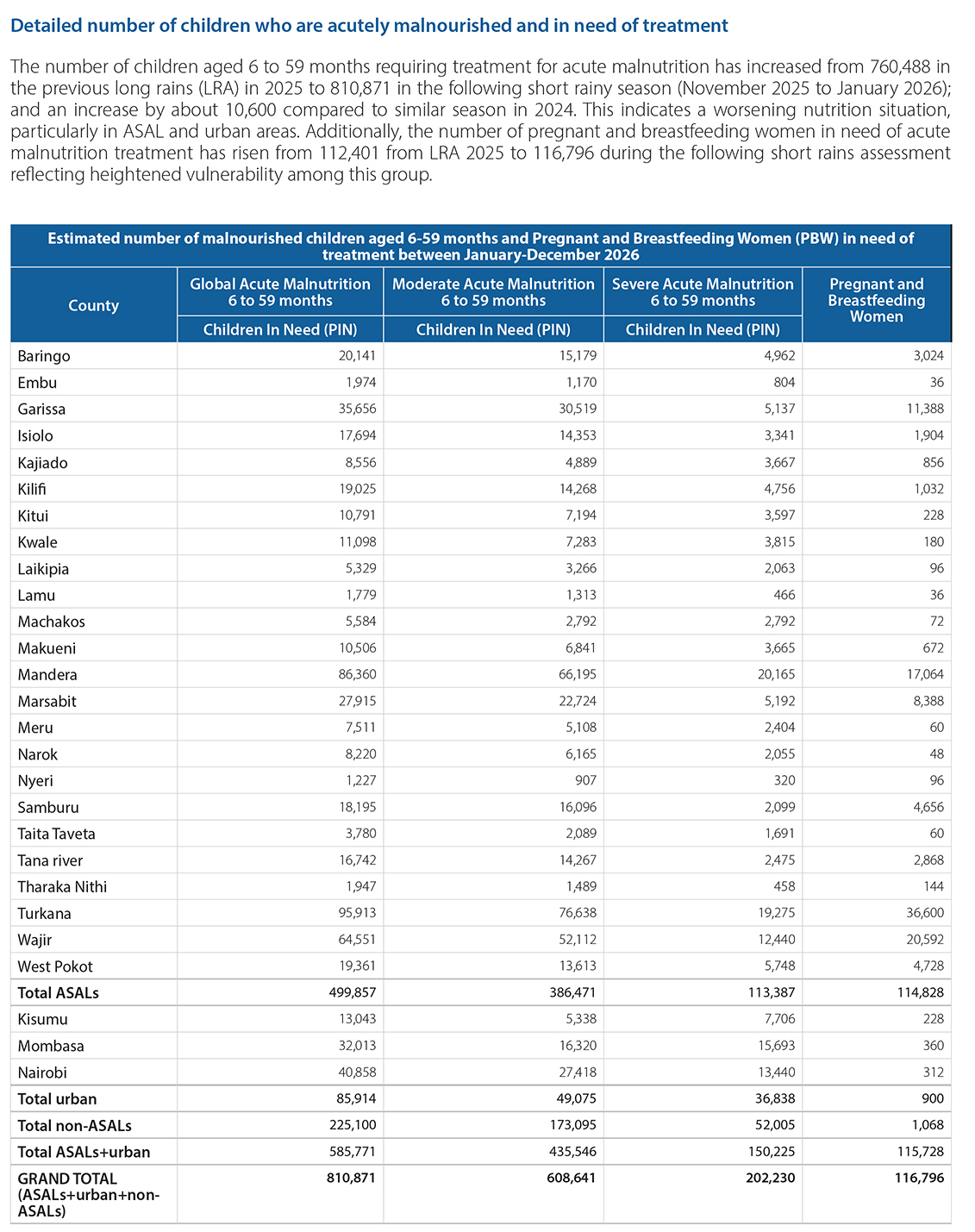
Around 810,871 cases of acutely malnourished children aged 6–59 months who require treatment throughout 2026 are confirmed, with 62 percent of cases in the ASAL counties. This is a significant deterioration compared to the 2025 analysis period where 760,488 children suffered acute malnutrition. Similarly, the number of pregnant and breastfeeding women requiring nutritional support has risen from 112,401 to 116,796. An urgent, large-scale, multisectoral response is required to prevent further deaths.
The deterioration in acute malnutrition is linked to prolonged drought, poor dietary diversity, low milk availability, and a high disease burden—including outbreaks of cholera, measles, mpox, and kalaazar—combined with weakened health and nutrition services due to reduced humanitarian funding.
Country Related Information
Contacts
- 01.01.2026 > 30.06.2026
Kenya: Acute Food Insecurity Situation for January - March 2026 and Projection for April - June 2026 - 01.07.2025 > 31.03.2026
Kenya: Acute Malnutrition Situation April 2025 - July 2025 and Projection for August 2025 - March 2026 (ASAL) - 01.07.2025 > 31.01.2026
Kenya: Acute Food Insecurity Situation for July - September 2025 and Projection for October 2025 - January 2026 (ASAL) - 01.10.2024 > 30.06.2025
Kenya: Acute Malnutrition Situation October 2024 - February 2025 and Projection for March - June 2025 (ASAL) - 01.02.2025 > 30.06.2025
Kenya: Acute Food Insecurity Situation for February - March 2025 and Projection for April - June 2025 (ASAL) - 01.07.2024 > 31.01.2025
Kenya: Acute Food Insecurity Situation for July - September 2024 and Projection for October 2024 - January 2025 (ASAL) - 04.09.2024 > 04.09.2024
Kenya: Acute Malnutrition Situation April - July 2024 and Projection for August - October 2024 (ASAL) - 01.10.2023 > 30.06.2024
Kenya: Acute Malnutrition Situation October 2023 - February 2024 and projection for March - June 2024 (ASAL) - 01.02.2024 > 30.06.2024
Kenya: Acute Food Insecurity Situation for February - March 2024 and Projection for April - June 2024 (ASAL) - 01.04.2023 > 31.10.2023
Kenya: Acute Malnutrition Situation April - July 2023 and projection for August - October 2023 (ASAL) - 01.07.2023 > 31.01.2024
Kenya: Acute Food Insecurity Situation for July - September 2023 and Projection for October 2023 - January 2024 (ASAL) - 01.02.2023 > 30.05.2023
Kenya: Acute Malnutrition Situation February 2023 and Projection for March - May 2023 - 01.02.2023 > 30.06.2023
Kenya: Acute Food Insecurity Situation February 2023 and Projection for March - June 2023 - 01.07.2022 > 31.10.2022
Kenya: Acute Malnutrition Situation July 2022 and Projection for August - October 2022 - 01.07.2022 > 31.12.2022
Kenya: Acute Food Insecurity Situation July - September 2022 and Projection October - December 2022 - 01.03.2022 > 30.06.2022
Kenya: Acute Malnutrition Projection Update March - June 2022 - 01.03.2022 > 30.06.2022
Kenya: Acute Food Insecurity Projection Update March - June 2022 - 01.02.2022 > 31.05.2022
Kenya: Acute Malnutrition Situation February 2022 and Projection for March - May 2022 - 01.02.2022 > 30.06.2022
Kenya: Acute Food Insecurity Situation February 2022 and Projection for March - June 2022 - 01.07.2021 > 31.01.2022
Kenya: Acute Food Insecurity Situation July - October 2021 and November 2021 - January 2022 - 01.07.2021 > 30.11.2021
Kenya: Acute Malnutrition Situation July 2021 and Projection for August - November 2021 - 01.02.2021 > 31.05.2021
Kenya: Acute Food Insecurity Situation February 2021 and Projection for March - May 2021 - 01.02.2021 > 31.05.2021
Kenya: Acute Malnutrition Situation February 2021 and Projection for March - May 2021 - 01.08.2020 > 01.12.2020
Kenya: Acute Food Insecurity Situation August - September 2020 and Projection for October - December 2020 - 01.08.2020 > 30.11.2020
Kenya: Acute Malnutrition Situation August 2020 and Projection for September - November 2020 - 01.02.2020 > 16.04.2020
Kenya: Acute Food Insecurity Situation February - March 2020 and Projection for April - July 2020 - 01.02.2020 > 31.05.2020
Kenya: Acute Malnutrition Situation February 2020 and Projection for March - May 2020 - 01.07.2019 > 31.10.2019
Kenya: Acute Food Insecurity Situation July 2019 and Projection for August - October 2019 - 01.07.2019 > 31.10.2019
Kenya: Acute Malnutrition Situation July 2019 and Projection for August - October 2019 - 01.08.2018 > 30.11.2018
Kenya: Acute Malnutrition Situation August 2018 and Projection for September - November 2018 - 01.08.2018 > 30.11.2018
Kenya: Acute Food Insecurity Situation August 2018 and Projection for September - November 2018 - 01.01.2018 > 30.04.2018
Kenya: Acute Malnutrition Situation in January 2018 and Projection for February-April 2018 - 01.07.2017 > 31.10.2017
Kenya: Acute Food Insecurity Situation in July 2017 and Projection for August - October 2017 - 01.01.2017 > 30.04.2017
Kenya: Acute Malnutrition Situation for January 2017 and February - April 2017 - 01.01.2017 > 30.04.2017
Kenya: Acute Food Insecurity Situation for January 2017 and February - April 2017 - 01.08.2016 > 31.01.2017
Kenya: Acute Food Security and Acute Malnutrition Situation from August 2016 to January 2017 - 01.02.2015 > 31.08.2015
Kenya: Acute Food Insecurity Situation February - August 2015 - 01.02.2016 > 31.07.2016
Kenya: Acute Food Insecurity Situation February - July 2016 - 01.02.2015 > 31.03.2015
Kenya: Acute Food Insecurity Situation February 2015 and Projection for March 2015 - 01.08.2014 > 28.02.2015
Kenya: Acute Food Insecurity Situation in August 2014 and Projection for September 2014 - February 2015 - 01.02.2014 > 28.02.2014
Kenya: Acute Food Insecurity Situation February 2014 - 01.08.2013 > 28.02.2014
Kenya: Pastoral Northwest Cluster Acute Food Insecurity Situation in August 2013 and Projection for September 2013 - February 2014
- 27.07.2026 > 05.08.2026
Kenya: Acute Food and Acute Malnutrition Analyses - 02.02.2026 > 13.02.2026
Kenya: Acute Food Insecurity and Acute Malnutrition Analyses - 28.07.2025 > 06.08.2025
Kenya: Acute Food Insecurity and Acute Malnutrition Analyses - 10.02.2025 > 18.02.2025
Kenya: Acute Food Insecurity Analysis

Join our mailing list