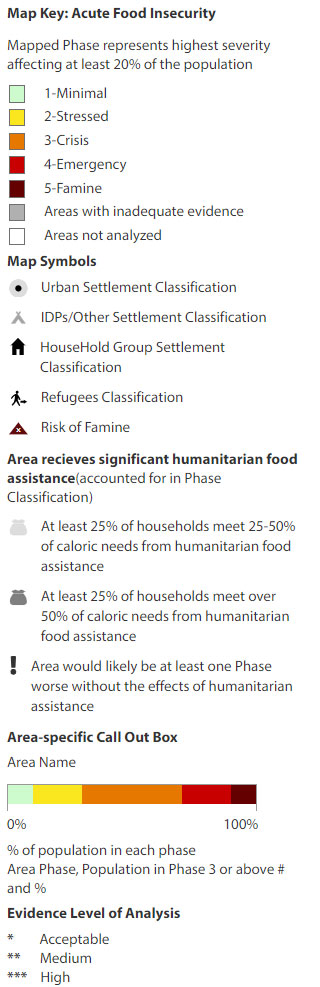
The acute food insecurity situation in Lebanon has further eased compared to the first half of 2025, but there are still a significant number of people facing high levels of acute food insecurity. Between November 2025 and March 2026, around 874,000 Lebanese residents, Syrian refugees, Palestine refugees and post-December 2024 arrivals from Syria continue experiencing IPC Phase 3 or above (Crisis or worse). This includes 22,000 people experiencing large food gaps and high levels of acute malnutrition, classified in IPC Phase 4 (Emergency) and 851,000 people in IPC Phase 3 (Crisis).
The reduction in the proportion of the population classified in IPC Phase 3 or above compared to the previous analysis conducted in March 2025, reflects a combination of factors, including the November 2024 ceasefire that enabled large-scale returns and restored market access and recovery; exchange rate stability and moderated inflation; seasonal income opportunities and remittances; and continued humanitarian assistance—despite funding cuts. However, food insecurity remains uneven and concentrated in high-severity pockets, particularly in the districts of Baalbek, El Hermel, Akkar, Bent Jbeil, Marjaayoun, El Nabatieh, and Sour, and among refugee populations.
The situation will deteriorate in the projection period (April to July 2026), with 961,000 people projected to face high levels of acute food insecurity (IPC Phase 3 or above), equivalent to 18 percent of the total analysed population. Vulnerability in Lebanon among all population groups is driven by the lingering economic crisis, slow reconstruction and funding shortfalls for humanitarian assistance.
Lifesaving and Humanitarian Food Security Assistance: Given the projected sharp reductions, it is critical to ensure transfer values remain aligned with updated SMEB/MEB costs. It is essential as well to continue contingency planning for localised access disruptions and maintain multi-sectoral operations in hard-to-reach and high-vulnerability areas and to the most vulnerable population groups, which will help mitigate risks, particularly for Syrian refugees and post-2024 arrivals, where no funding is confirmed beyond April 2026. At the same time, advocating for multi-year, flexible funding commitments from donors and international partners is essential to sustain humanitarian operations and prevent pipeline breaks. Exploring innovative financing mechanisms, including blended humanitarian-development approaches, can help bridge gaps and support long-term recovery.
Social safety net systems: Strengthening and expanding national and humanitarian social assistance programs is necessary to address poverty and vulnerability. This includes supporting the continuation of the World Bank-funded Emergency Social Safety Net Project (ESSN), also known as AMAN, seeking additional funding for shock-responsive mechanisms, and improving targeting systems and data integration between national and humanitarian schemes. Linking assistance with protection and legal aid for individuals lacking documentation will ensure equitable coverage.
Targeted support for post-2024 arrivals: Given the projected deterioration in food security among the post-2024 arrivals—where prevalence of Phase 3 or above is expected to reach 55 percent and humanitarian food assistance coverage will drop from 25 percent to zero by April 2026—it is critical to prioritise emergency support for this population group. This includes maintaining contingency pipelines for rapid response in high-severity districts such as Akkar, Tripoli, and Baalbek-Hermel, and deploying short-term assistance mechanisms such as vouchers or in-kind distributions to prevent households from falling into Phase 4. Integrating protection and mobility support, particularly in areas where movement is restricted, and advocating for earmarked donor funding will be essential to mitigate risks and address acute vulnerability among this group.
Livelihood assistance: Scaling up cash-for-work and short-term employment schemes focused on recovery efforts, infrastructure rehabilitation, and public service support in return areas should be prioritised. Providing grants and input support to conflictaffected Micro, Small, and Medium Enterprises (MSMEs), particularly in agriculture, retail, and services, and promoting inclusive job opportunities for women and youth through vocational training and microenterprise support will strengthen resilience.
Agricultural rehabilitation and food system recovery: Rehabilitating irrigation systems, feeder roads, and storage facilities, facilitating access to seeds, fertilisers, and livestock feed for smallholders, and supporting livestock restocking and vaccination programs are priorities. Promoting climate-resilient and diversified production systems, rebuilding food processing facilities and marketplaces, and strengthening local value chains through inclusive procurement practices will help stabilise food availability.
Support to recovery of food systems: Rehabilitating food systems is critical to ensuring sustainable access to food in conflictaffected areas. Recommended interventions include: supporting the recovery of food processing facilities, storage units, marketplaces, and bakeries through the provision of equipment, raw materials, and micro-grants or loans. Rebuilding feeder roads and transport infrastructure to facilitate the movement of goods and reintegrate rural production zones into national supply chains. Strengthening local food value chains through inclusive procurement practices, such as linking school feeding or institutional buyers to smallholder cooperatives.
Education and school feeding programs: Scaling up school feeding programs targeting displaced and host community children in priority districts, linking school feeding to local food production, and integrating nutrition and psychosocial services into education responses will help mitigate negative coping strategies such as child labor and school dropout.
Integrate nutrition sensitive activities: Embedding nutrition-sensitive interventions across food security and recovery efforts is necessary to improve dietary diversity and nutritional outcomes. This includes promoting community education, ensuring access to fortified foods, and strengthening collaboration between agriculture, health, and social protection systems.


 RELEASE DATE
 VALIDITY PERIOD