


> Resources

RESOURCES
Latest resources
Filtered by:
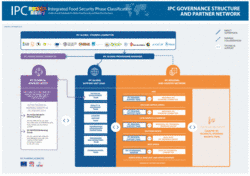
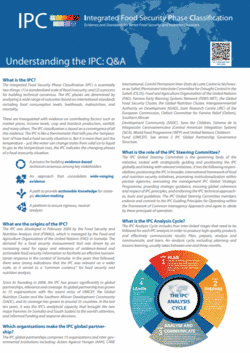
IPC Governance Structure and Global Partner Network
IPC Covernance Structure and Global Partner Network
Brochures | 08/10/2019 | Global
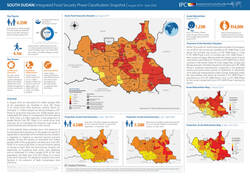
South Sudan: Acute Food Security Snapshot August 2019 – April 2020
Infographics | 11/09/2019 | Eastern Africa | South Sudan
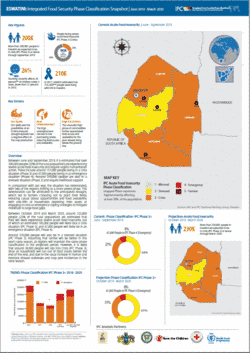
Eswatini: Acute Food Security Snapshot June - September 2019 and Projection for October 2019 - March 2020
Between June and September 2019, it is estimated that over 200,000 people (20% of the rural population) are experiencing severe acute food insecurity and require urgent humanitarian action. These include around 157,000 people being in a crisis situation (Phase 3) and 47,000 people being in an emergency situation (Phase 4). Around 370,000 people are also in a stressed situation (Phase 2) and require livelihood support.
Click here [...]
Infographics | 02/07/2019 | Southern Africa | Swaziland
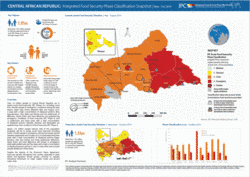
Central African Republic: Acute Food Insecurity Situation May - October 2019
Between May and August 2019, 5 areas with a high concentration of displaced persons (Bria, Kaga-Bandoro, Obo, Rafai and Zémio) and the prefectures of Mbomou, Haute Kotto and Haut Mbomou are experiencing emergency conditions of food insecurity (IPC Phase 4), and 13 prefectures and 3 areas with a high concentration of displaced persons (Alindao, Bambari and Batangafo) are experiencing crisis conditions of food insecurity (IPC Phase 3). 1.8 [...]
Infographics | 20/06/2019 | Central Africa | Central African Republic
Final Evaluation of the Integrated Food Security Phase Classification (IPC) Global Strategic Programme (GSP) 2014-2018
This is the final evaluation of the first phase of the Integrated Food Security Phase Classification (IPC) Global Strategic Programme (GSP), from 2014 to 2018. Focused at a strategic level, the evaluation has a strong learning purpose; it makes recommendations for the next phase of the GSP. It also fulfils an accountability purpose to the GSP’s three donor agencies. The overall strategic objective of the GSP is that [...]
Reports | 01/03/2019 | Global
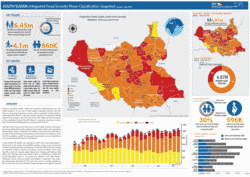
South Sudan: Acute Food Insecurity and Malnutrition Situation January - July 2019
Owing to relentless armed conflict and population displacement, over 6.45 million people or 57 per cent of South Sudan’s population will face Crisis (IPC Phase 3) acute food insecurity or worse, with an estimated 45,000 people in Catastrophe (IPC Phase 5). The food security situation is projected to further deteriorate from May to July 2019, with about 6.87 million people (60 percent of the population) facing Crisis (IPC [...]
Infographics | 22/02/2019 | Eastern Africa | South Sudan
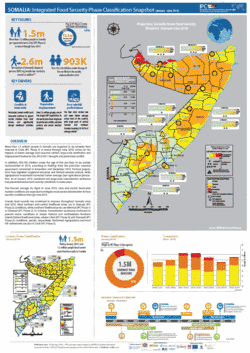
Somalia: Acute Food Insecurity Situation January - June 2019
Click here to download the snapshot.
Infographics | 15/02/2019 | Eastern Africa | Somalia
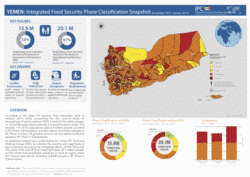
Yemen: Acute Food Insecurity Situation December 2018 – January 2019
Click here to download the snapshot.
Infographics | 17/12/2018 | Asia and Near East | Yemen
Filter resources by
Join our mailing list