



- © WFP
AFGHANISTAN: Recent improvements threatened as 17.4 million people face high levels of acute food insecurity; 3.7 million children suffering acute malnutrition
Prolonged economic deterioration, recurrent drought, and a significant reduction in humanitarian assistance have left large segments of the population unable to meet their minimum food needs. Despite the scale of these pressures, many households have so far avoided more severe outcomes by maintaining some level of food production, retaining livestock, and limiting the use of irreversible coping strategies, supported by large-scale lifesaving emergency agriculture and food assistance delivered in recent years. As humanitarian food security assistance declines, these buffers are eroding and vulnerabilities are re-emerging, underscoring the fragility and reversibility of recent food security improvements in Afghanistan.
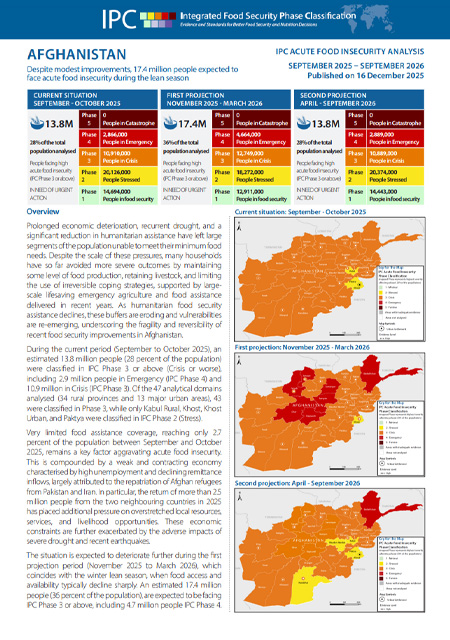
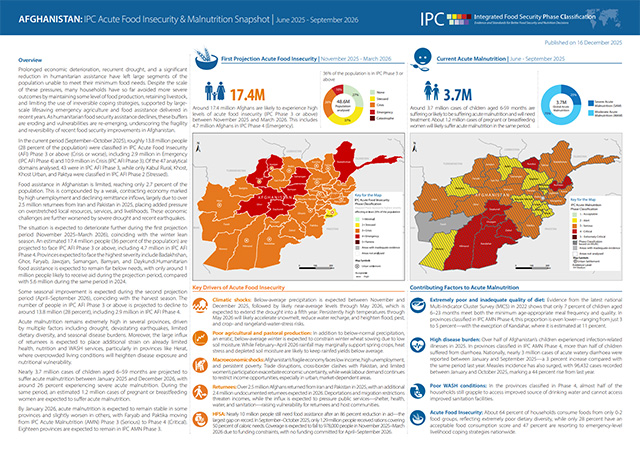
In the current period (September–October 2025), roughly 13.8 million people (28 percent of the population) were classified in IPC Acute Food Insecurity (AFI) Phase 3 or above (Crisis or worse), including 2.9 million in Emergency (IPC AFI Phase 4) and 10.9 million in Crisis (IPC AFI Phase 3).
Food assistance in Afghanistan is limited, reaching only 2.7 percent of the population. This is compounded by a weak, contracting economy marked by high unemployment and declining remittance inflows, largely due to over 2.5 million returnees from Iran and Pakistan in 2025, placing added pressure on overstretched local resources, services, and livelihoods. These economic challenges are further worsened by severe drought and recent earthquakes.
The situation is expected to deteriorate further during the first projection period (November 2025–March 2026), coinciding with the winter lean season. An estimated 17.4 million people (36 percent of the population) are projected to face IPC AFI Phase 3 or above, including 4.7 million in IPC AFI Phase 4. Some seasonal improvement is expected during the second projection period (April–September 2026), coinciding with the harvest season. The number of people in IPC AFI Phase 3 or above is projected to decline to around 13.8 million (28 percent), including 2.9 million in IPC AFI Phase 4.
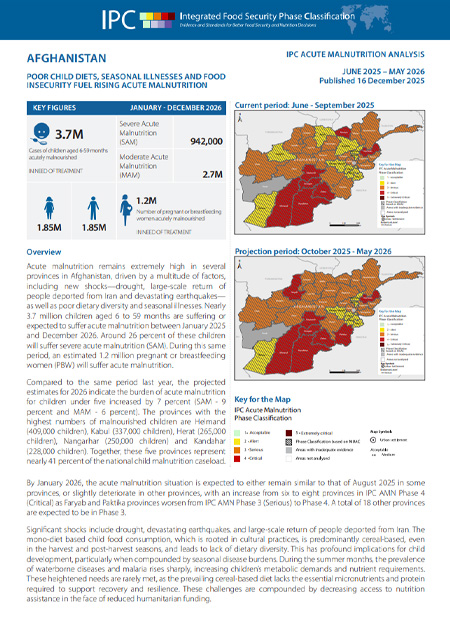
Acute malnutrition remains extremely high in several provinces, driven by multiple factors including drought, devastating earthquakes, limited dietary diversity, and seasonal disease burdens. Moreover, the large influx of returnees is expected to place additional strain on already limited health, nutrition and WASH services. Nearly 3.7 million cases of children aged 6–59 months are projected to suffer acute malnutrition between January 2025 and December 2026, with around 26 percent experiencing severe acute malnutrition. During the same period, an estimated 1.2 million cases of pregnant or breastfeeding women are expected to suffer acute malnutrition.
Join our mailing list