



- © UNICEF
SOUTH SUDAN: Conflict sustains high levels of acute food insecurity and malnutrition, keeping Luakpiny/Nasir County at Risk of Famine
Food insecurity and malnutrition in South Sudan remain extremely high, driven primarily by localised conflict and expanding civil insecurity that have displaced large populations, as well as by widespread flooding that continues to disrupt livelihoods and agricultural production.
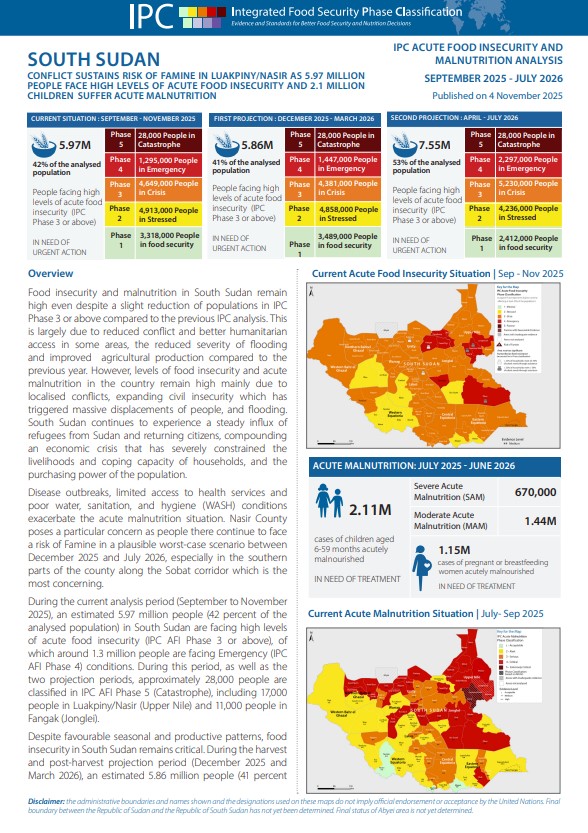
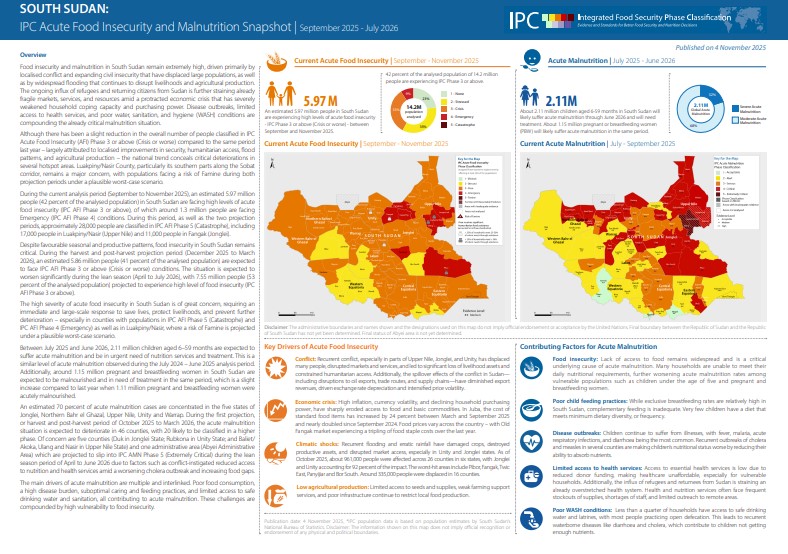
During the current analysis period (September to November 2025), an estimated 5.97 million people (42 percent of the analysed population) in South Sudan are facing high levels of acute food insecurity (IPC AFI Phase 3 or above), of which around 1.3 million people are facing Emergency (IPC AFI Phase 4) conditions. During this period, as well as the two projection periods, approximately 28,000 people are classified in IPC AFI Phase 5 (Catastrophe), including 17,000 people in Luakpiny/Nasir (Upper Nile) and 11,000 people in Fangak (Jonglei). Luakpiny/Nasir County, particularly its southern parts along the Sobat corridor, remains a major concern, with populations facing a risk of Famine during both projection periods under a plausible worst-case scenario.
During the harvest and post-harvest projection period (December 2025 and March 2026), an estimated 5.86 million people (41 percent of the analysed population) are expected to face IPC AFI Phase 3 or above (Crisis or worse) conditions. The situation is expected to worsen significantly during the lean season (April to July 2026), with 7.55 million people (53 percent of the analysed population) projected to experience high levels of food insecurity (IPC AFI Phase 3 or above).
Between July 2025 and June 2026, 2.11 million children aged 6–59 months are expected to suffer acute malnutrition and be in urgent need of nutrition services and treatment. Additionally, around 1.15 million pregnant and breastfeeding women in South Sudan are expected to be malnourished and in need of treatment in the same period.
An estimated 70 percent of acute malnutrition cases are concentrated in the five states of Jonglei, Northern Bahr el Ghazal, Upper Nile, Unity and Warrap. During the first projection, or harvest and post-harvest period of October 2025 to March 2026, the acute malnutrition situation is expected to deteriorate in 46 counties, with 20 likely to be classified in a higher phase. Of concern are five counties (Duk in Jonglei State; Rubkona in Unity State; and Baliet/Akoka, Ulang and Nasir in Upper Nile State) and one administrative area (Abyei Administrative Area) which are projected to slip into IPC AMN Phase 5 (Extremely Critical) during the lean season period of April to June 2026 due to factors such as conflict-instigated reduced access to nutrition and health services amid a worsening cholera outbreak and increasing food gaps.
Resources
South Sudan: Acute Food Insecurity Situation for September - November 2025 and Projections for December 2025 - March 2026 and for April - July 2026
South Sudan: Acute Malnutrition Situation for September - November 2025 and Projections for December 2025 - March 2026 and for April - July 2026
Join our mailing list