


- © WFP
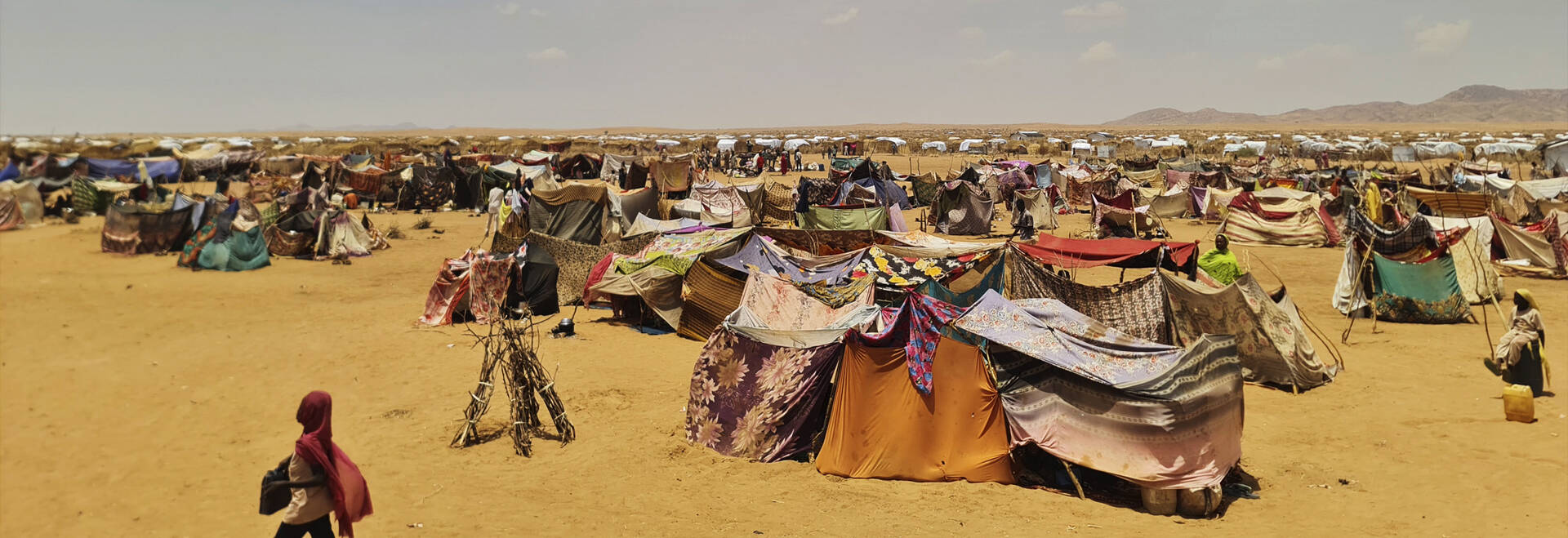
SUDAN: Famine confirmed in El Fasher and Kadugli towns, 20 other areas at risk of Famine
As of September 2025, El Fasher town (North Darfur) and the besieged town of Kadugli (South Kordofan) were classified in Famine (IPC Phase 5) with reasonable evidence. These conditions are expected to persist through January 2026. The situation in the besieged town of Dilling (South Kordofan) is estimated to be similar to that in Kadugli town; however, the lack of data prevents IPC classification of this area.
Uncertainty surrounding the evolution of conflict heightens the risk of Famine, particularly in 20 areas expected to receive displaced populations across North, South, and East Darfur, as well as West and South Kordofan.
In September 2025, at the peak of the lean season, an estimated 21.2 million people—45 percent of the population—faced high levels of acute food insecurity (IPC Phase 3 or above), including 375,000 people in IPC Phase 5 (Catastrophe) and 6.3 million people in IPC Phase 4 (Emergency).
Food security conditions will improve after the harvest, resulting in a decline in the number of people in IPC Phase 3 or above to 19.2 million people from October 2025 to January 2026. However, in North Darfur and the Western Nuba Mountains, gains from the harvest will remain limited due to conflict and insecurity. During the post-harvest and pre-lean season (February - May 2026), acute food insecurity is projected to worsen with an estimated 19.1 million people (41%) expected to face IPC Phase 3 or above conditions. This apparent reduction in numbers is primarily due to the inability to classify several high-concern areas
The full IPC analysis report will be published in the coming weeks.
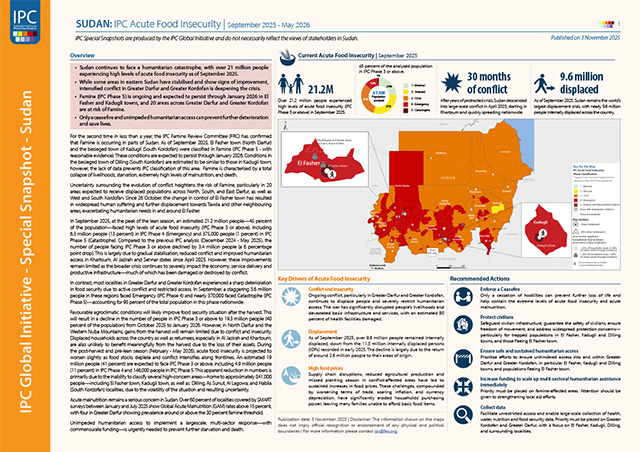
Download the Snapshot
Famine Review of the IPC Analysis
The Famine Review Committee (FRC) has reviewed an analysis conducted by the IPC Global Initiative to determine whether famine is occurring in parts of Sudan. The FRC has concluded that, for the current period of analysis (September 2025), and for the first projection period (October 2025 to January 2026), the classification of the towns of El Fasher and Kadugli in IPC Phase 5 (Famine) with reasonable evidence) is plausible.
In the besieged town of Dilling, although the situation might be similar to that of Kadugli besieged town, the FRC was unable to determine whether a Famine classification is plausible due to extremely limited data.
Uncertainty around the evolution of the conflict in the coming weeks and months raises a risk of Famine in areas surrounding the three towns, including Tawila, Melit and At Tawisha localities and the Western Nuba Mountains.
Assistance for populations in Famine and the risk of Famine is an urgent prioritiy, but they are only the most severe symptoms of a far broader and deepening crisis affecting millions across Sudan. This is a man-made emergency, and the steps needed to prevent further catastrophe are clear: halt the conflict, protect civilians, enable full humanitarian and commercial access, and strengthen local aid efforts.
humanitarian and commercial access, and strengthen local aid efforts.Download the report
IPC FAMINE FACT SHEET: Learn more about the IPC Famine Classification
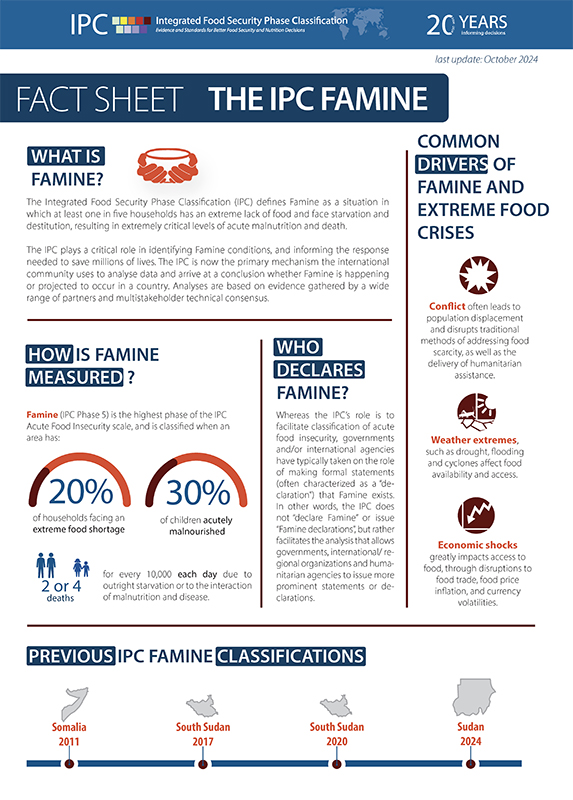
The Integrated Food Security Phase Classification (IPC) defines Famine as a situation in which at least one in five households has an extreme lack of food and faces starvation and destitution, resulting in extremely critical levels of acute malnutrition and death.
The IPC plays a critical role in identifying Famine conditions, and informing the response needed to save millions of lives. The IPC is now the primary mechanism the international community uses to analyse data and arrive at a conclusion whether Famine is happening in a country. Analyses are based on evidence gathered by a wide range of partners and multistakeholder technical consensus.
Download IPC Famine Factsheet
Join our mailing list