


- © UNICEF
A new IPC analysis was initially scheduled for early October. However, due to the highly volatile conditions in recent weeks and significant population movements, it was not feasible to conduct a reliable analysis at this time. Proceeding with the exercise following the recent major changes in conditions would not accurately reflect the current situation on the ground. The next IPC analysis is tentatively planned for November, with the aim of capturing the latest developments in the Gaza Strip more comprehensively.
GAZA STRIP: Famine confirmed in Gaza Governorate, projected to expand
As of 15 August 2025, Famine (IPC Phase 5)—with reasonable evidence—is confirmed in Gaza Governorate. After 22 months of relentless conflict, over half a million people in the Gaza Strip are facing catastrophic conditions characterised by starvation, destitution and death. Another 1.07 million people (54 percent) are in Emergency (IPC Phase 4), and 396,000 people (20 percent) are in Crisis (IPC Phase 3).
Between mid-August and the end of September 2025, conditions are expected to further worsen with Famine projected to expand to Deir al-Balah and Khan Younis. Nearly a third of the population (641,000 people) are expected to face catastrophic conditions (IPC Phase 5), while those in Emergency (IPC Phase 4) will likely rise to 1.14 million (58 percent). Acute malnutrition is projected to continue worsening rapidly.
Through June 2026, at least 132,000 children under five are expected to suffer from acute malnutrition—double the IPC estimates from May 2025. This includes over 41,000 severe cases of children at heightened risk of death. Nearly 55,500 malnourished pregnant and breastfeeding women will also require urgent nutrition response.
Despite limited data, conditions in North Gaza Governorate are estimated to be as severe—or worse—than in Gaza Governorate.
Download the IPC Special Snapshot on the Gaza Strip
The full IPC analysis report will be published in the coming weeks.

Famine Review of the IPC Analysis
The Famine Review Committee (FRC) has reviewed an analysis conducted by a multi-agency, multi-sectoral analysis team to determine the current and projected acute food security and nutrition situation in the Gaza Strip. The FRC has determined that Famine (IPC Phase 5) is currently occurring in Gaza Governorate. Furthermore, the FRC projects Famine (IPC Phase 5) thresholds to be crossed in Deir al-Balah and Khan Younis Governorates in the coming weeks. As this Famine is entirely man-made, it can be halted and reversed. The time for debate and hesitation has passed, starvation is present and is rapidly spreading. There should be no doubt in anyone’s mind that an immediate, at-scale response is needed. Any further delay—even by days—will result in a totally unacceptable escalation of Famine-related mortality. If an immediate and sustained ceasefire is not implemented to allow humanitarian aid to reach everyone in the Gaza Strip, and if essential food supplies, and basic health, nutrition, and WASH services are not restored immediately, avoidable deaths will increase exponentially.
Download the FRC Report
Learn more about the Famine Review Committee

Addendum to the Famine Review Committee (FRC) report on the Gaza Strip- August 2025
An addendum to the Famine Review Committee (FRC) report on the Gaza Strip- August 2025- has been added in order to clarify the data on Acute Malnutrition used by the FRC in their review.
Response to Issues Raised Following IPC’s Famine Classification in the Gaza Strip
Following the IPC analysis published on 22 August 2025—which confirmed Famine in Gaza Governorate and projected its expansion to Deir al-Balah and Khan Younis Governorates by the end of September 2025—several questions have been raised about how the analysis was conducted. Please find the IPC response here
It is important to stress that these issues must not distract from the most urgent matter: stopping the Famine, preventing its spread, and averting further loss of life and catastrophic suffering in the Gaza Strip. Immediate action is imperative. Lives depend on it.
FEWS NET ANALYSIS: Famine is now occurring in northern Gaza and expected to expand to southern Gaza
See the findings of the Famine Early Warning Systems Network (FEWS NET) regarding the acute food security situation in the Gaza Strip.
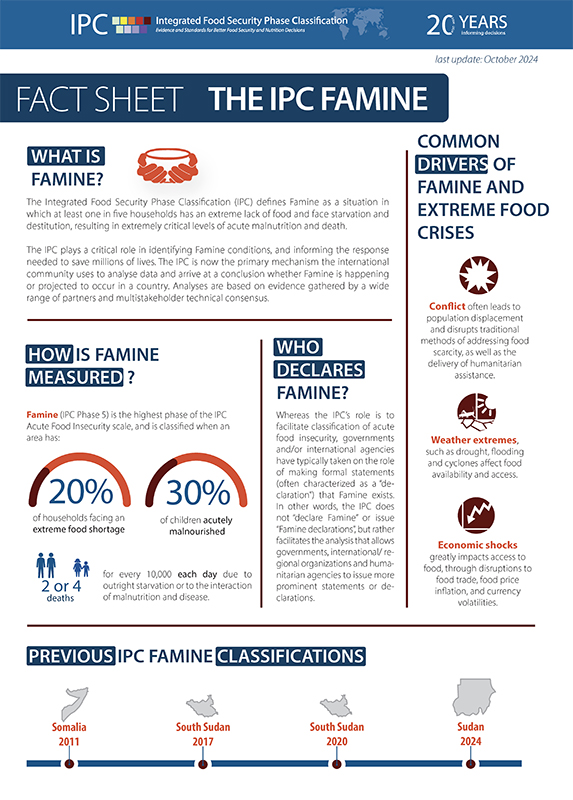
IPC FAMINE FACT SHEET: Learn more about the IPC Famine Classification
The Integrated Food Security Phase Classification (IPC) defines Famine as an extreme deprivation of food. Starvation, death, destitution and extremely critical levels of acute malnutrition are or will likely be evident.
The IPC plays a critical role in identifying Famine conditions, and informing the response needed to save millions of lives. The IPC is now the primary mechanism the international community uses to analyse data and arrive at a conclusion whether Famine is happening or likely happening in a country. Analyses are based on evidence gathered by a wide range of partners and multistakeholder technical consensus.
Download IPC Famine Factsheet
Join our mailing list