


IPC Famine Fact Sheet
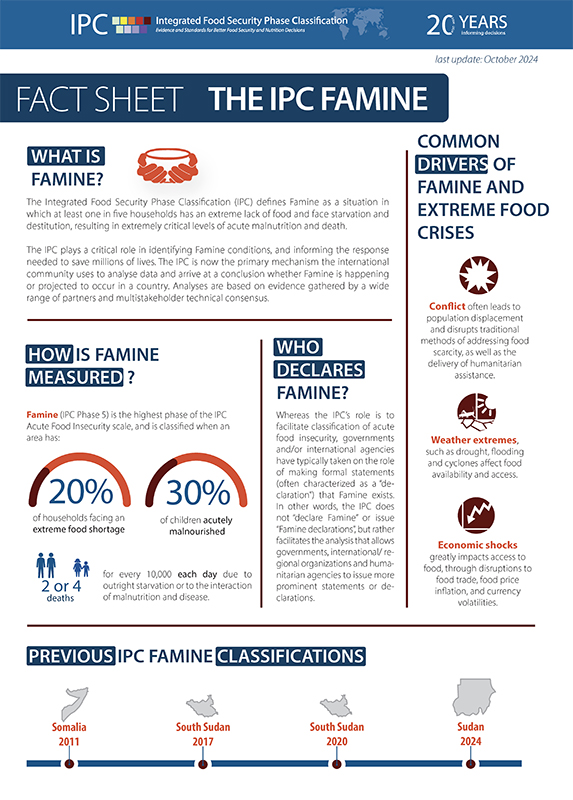
The Integrated Food Security Phase Classification (IPC) defines Famine as a situation in which widespread starvation and destitution, acute malnutrition, and deaths are occurring concurrently.
The IPC is the primary mechanism the international community uses to analyse data and arrive at a conclusion of whether Famine is happening or projected to occur. Its analyses follow strict, transparent protocols that bring together data and expertise from a wide range of partners to reach an evidence-based technical consensus. These protocols are specifically designed to provide strong early warning signals. All Famine classifications undergo independent review by the IPC Famine Review Committee
Download the IPC Famine Fact Sheet: English
Know more about the IPC’s Acute Food Insecurity Scale with Nicholas Haan
WHAT IS FAMINE?
What is Famine?
The IPC defines Famine (IPC Phase 5) as a situation in which widespread starvation and destitution, acute malnutrition, and deaths are occurring concurrently. More specifically:
- 20% of households in an area face an extreme lack of food and a near complete collapse of their livelihoods and depletion of their assets. (These definitions refer strictly to the observed conditions and do not imply causality, intent, or alignment with any legal denitions.)
- At least 30% of children under five suffer from acute malnutrition measured by Weight-for-Height (WHZ) and/or bilateral oedema, or approximately 15% of children under five suffer from acute malnutrition measured by Mid-Upper Arm Circumference (MUAC), and/or bilateral oedema.
- There are more than two non-trauma deaths among adults per 10,000 people per day, or four or more deaths per 10,000 children under five per day.
THE IPC ACUTE FOOD INSECURITY SCALE
THE IPC 5-POINT SCALE: AN EARLY WARNING SYSTEM
The IPC five‑point acute food insecurity scale acts as a global early warning system to help prevent Famine before it occurs. When an area reaches IPC Phase 4 (Emergency), at least 20 percent of households already face severe food shortages or collapsing livelihoods, calling for urgent humanitarian assistance. If some households are in IPC Phase 5 (Catastrophe) within an IPC Phase 4 (Emergency) area, additional immediate action is required to halt starvation and destitution.
1
Phase 1 None/Minimal
Households are able to meet essential food and non-food needs without engaging in atypical and unsustainable strategies to access food and income.
2
Phase 2 Stressed
Households have minimally adequate food consumption but are unable to afford some essential non-food expenditures without engaging in stress-coping strategies.
3
| Phase 3 Crisis | |
| Households either: • Have food consumption gaps that are reflected by high or above-usual acute malnutrition; |
or • Are marginally able to meet minimum food needs but only by depleting essential livelihood assets or through crisis-coping strategies |
4
| Phase 4 Emergency | |
| Households either: • Have large food consumption gaps which are reflected in very high acute malnutrition and excess mortality; |
or • Are able to mitigate large food consumption gaps but only by employing emergency livelihood strategies and asset liquidation |
5
| Phase 5 Catastrophe/ Famine | |
| Households have an extreme lack of food and/or other basic needs even after full employment of coping strategies. Starvation, death, destitution and extremely critical acute malnutrition levels are evident. | For Famine Classification, area needs to have extreme critical levels of acute malnutrition and mortality. |
FAMINE VS CATASTROPHE
Famine
is a classification applied only at the area level. It indicates that widespread starvation, widespread acute malnutrition and excess deaths are occurring at the same time in an area.
Catastrophe
is applied only at the household level. It describes conditions in which households are experiencing starvation and destitution, and are at high risk of, if not already experiencing, acute malnutrition and death.
FAMINE CLASSIFIED WITH SOLID OR REASONABLE EVIDENCE
Famine with solid evidence
An area is classified in Famine with solid evidence when there is clear and compelling evidence that all three required conditions are occurring at the same time.
Famine with reasonable evidence
An area is classified in Famine with reasonable evidence if there is clear and compelling evidence for two of the three conditions required for Famine classification, and analysts judge—based on the broader body of evidence—that the threshold for the third condition is also likely met.
RISK OF FAMINE
Risk of Famine indicates that there is a real possibility that an area could fall into Famine (IPC Phase 5) in the near future—even if Famine is not the most likely outcome based on current information.
KEY FACTS ABOUT RECENT FAMINES
KEY FACTS ON PREVIOUS FAMINES
In the last 15 years, Famine has been confirmed on six occasions: in Somalia in 2011, South Sudan in 2017 and 2020, Sudan in 2024 and 2025, and the Gaza Strip in 2025. These extreme conditions were characterised by widespread starvation, destitution and acute malnutrition, and resulted in tens of thousands of preventable deaths. These Famines were overwhelmingly driven by armed conflict and restrictions on humanitarian access.
Sudan, 2025
In September 2025, the IPC Famine Review Committee concluded that Famine (IPC Phase 5 - with reasonable evidence) was ongoing and likely to persist through January 2026 in the towns of El Fasher (North Darfur) and Kadugli (South Kordofan). At the time of the analysis, the devastating civil war that erupted in April 2023 had internally displaced approximately 9.8 million people—around 20 percent of the population—and forced an additional 4.3 million individuals to flee to neighbouring countries. According to the IPC analysis, over 21 million people were experiencing high levels of acute food insecurity (IPC Phase 3 or above), underscoring the scale and severity of the humanitarian crisis.
Link to the in-focus page:
SUDAN: Famine confirmed in El Fasher and Kadugli towns, 20 other areas at risk of Famine
Gaza Strip, 2025
In August 2025, the IPC determined that Famine (IPC Phase 5) was occurring in Gaza Governorate and projected to expand to Deir al-Balah and Khan Younis governorates in the following weeks. For 22 months the Gaza Strip teetered on the brink of Famine, driven by relentless conflict. Over half a million people in the Gaza Strip faced catastrophic conditions (IPC Phase 5), characterised by starvation, destitution and death. Another 1.07 million people—54 percent of the population—faced Emergency (IPC Phase 4), and 396,000 people (20 percent) faced Crisis (IPC Phase 3). This was the most severe deterioration since the IPC began analysing acute food insecurity and acute malnutrition in the Gaza Strip, and it marked the first time a Famine was officially confirmed in the Middle East region.
Link to in-focus page:
GAZA STRIP: Famine confirmed in Gaza Governorate, projected to expand
Sudan, 2024
In December 2024, the IPC detected Famine in at least five areas and projected that five additional areas would face Famine between December 2024 and May 2025. Half of Sudan’s population (24.6 million people) faced high levels of acute food insecurity. This marked an unprecedented deepening and widening of the food and nutrition crisis, driven by the devastating conflict, which triggered mass displacement, a collapsing economy, the breakdown of essential social services, and severe societal disruptions, combined with poor humanitarian access.
Link to the in-focus page:
FAMINE IN SUDAN: IPC Famine Review Committee Confirms Famine in parts of North Darfur
South Sudan, 2020
In November 2020, the IPC concluded that four payams in Pibor county, Jonglei State - namely Gumuruk, Pibor, Lekuangole, Verteth payams - experienced Famine Likely (IPC Phase 5) conditions. Pibor was particularly affected by violence and flooding, which destroyed homes, livelihoods, burned to the ground key infrastructure, caused massive displacements, cut off access to humanitarian services, and created almost insurmountable operational challenges for humanitarians delivering aid. These local shocks, combined with economic hardship, in particular significant increase in prices, drove tens of thousands of people into Famine.
Link to in-focus page:
South Sudan: IPC Results October 2020 - July 2021
South Sudan, 2017
Famine was declared in parts of South Sudan in February 2017, where nearly 80,000 people were in Catastrophe (IPC Phase 5) in parts of Unity State (the central-northern part of South Sudan), with another one million people classified in Emergency (IPC Phase 4). By then, three years of civil war had devastated livelihoods, coupled with an ailing economy and high food prices. Unity State, which borders Sudan, was at the centre of some of the fiercest fighting, forcing tens of thousands of people to flee their homes into displacement camps.
Link to analysis:
South Sudan: Acute Food Insecurity Situation for January 2017 and Projections for February - April 2017 and May - July 2017
Somalia, 2011
In July 2011, the FAO-managed Food Security and Nutrition Analysis Unit for Somalia (FSNAU) and the Famine Early Warning Systems Network (FEWS NET) classified Famine in parts of Southern Somalia including Balcad and Cadale districts of Middle Shabelle, the Afgoye corridor IDP settlement, and the Mogadishu IDP community. About 490,000 people in Somalia were in Catastrophe (IPC Phase 5) and experiencing these conditions due to conflict and drought.
Link to analysis:
FEWS NET FSNAU EA Evidence for a Famine Declaration
HOW TO AVOID & REVERT FAMINE
Famines must be prevented at all costs, and strong monitoring and early‑warning systems play a crucial role in avoiding them. However, when Famine conditions are detected, the IPC recommends immediate action to reverse the catastrophe and prevent further suffering and loss of life including the following:

Cessation of Conflicts
Ending active hostilities is essential in contexts where conflict drives food insecurity. Restoring stability enables communities to resume economic activity, rebuild basic services, and begin recovering their livelihoods.

Humanitarian Access
Ensuring safe and reliable access allows aid organisations to reach affected populations consistently, establish operations, and deliver critical resources where they are most needed.

Multi-sectoral Response
Addressing Famine requires more than food assistance alone. Coordinated actions across agriculture, health, nutrition, water and sanitation (WASH), and other essential services help protect communities from further livelihood losses and social breakdown.

Sustained monitoring and response
Regular assessment of food security and nutrition conditions helps identify worsening trends and ensures that measures to protect households—and prevent deterioration—are maintained over time.
Download the IPC Famine Fact sheet: English
Join our mailing list