


IPC Funding and Priority areas
January 2026
IPC Funding Status - Global Strategic Programme 2023-2026
USD $32.3 M, funding approved for the GSP 2023-2026
Approx USD $0.7 M, funding recently approved for the GSP 2023-2026*
The overall costing of the IPC Global Strategic Programme was updated in late 2025 from USD 39 million down to USD 33 million. This reduction reflects, from 2026 a stronger focus on analysis of the worst food and nutrition crises, and a narrower focus on fundamental technical and information systems developments. Cost containment measures introduced in 2025 (see box below) will remain in place throughout 2026.
* Recent contributions from Canada and EU extend beyond the end of the GSP 2023-2026, providing initial funding for the upcoming IPC GSP 2027-2030
IPC Funding Partners
For over two decades, the Integrated Food Security Phase Classification (IPC) has served as the global standard for the analysis and classification of food insecurity and malnutrition, systematically informing decisions in countries facing food and nutrition crises.
Central to this success is the IPC funding model, which relies on voluntary contributions. Currently, the European Union, the Foreign, Commonwealth & Development Office of the United Kingdom, Global Affairs Canada, and the Government of the Federal Republic of Germany, represented by the Federal Ministry for Economic Cooperation and Development play a crucial role in supporting the IPC's mission through their financial contributions.
Thanks to this funding, the IPC initiative is able to:
- Deliver high-quality, timely information on food and nutrition crises in 30 countries.
- Provide systematic training for IPC practitioners worldwide for the delivery of robust IPC analyses.
- Continuously advance technical standards that underpin IPC analyses.
- Leverage advanced technologies and artificial intelligence in support of the human-led process.
Beyond financial support, resource partners play a fundamental role in the strategic dialogue within the IPC initiative which embodies a shared commitment to fight food and nutrition crises and improve the lives of millions through better food and nutrition outcomes.



Secured Funding vs. Budget Needs (through 2028)
Current Funding
Financial Gap
Required Funding
Cost containment measures
The IPC Initiative has already put in place several measures aimed at enhancing programme stability in 2026, including:
Human Resources
- All new recruitments foreseen within the current IPC Global Strategic Programme (2023-2026) have been cancelled, leaving 9 new positions unfilled.
- Existing vacant positions (3) will remain unfilled.
- The stabilization of key positions through the transition to longer-term staff contracts – rather than temporary assignments – has been put on hold.
- Salary levels have been frozen where contract types allow
Support to IPC activities
- Direct financial support to country activities (IPC training and analyses) has been reduced and focused on worst food and nutrition crises.
- Face-to-face activities and meetings including training for IPC certification have been significantly scaled back.
- Careful planning of support to countries and strategic use of regional and country level capacity have been prioritized to optimize the balance between travel-related costs and the provision of adequate technical support.
Impact of funding gap
The cost containment measures put in place in early 2025, coupled with a recent financial contribution provided by the EU enabled the IPC to bridge the financial gap for 2026. However, a critical financial gap remains in 2027 and beyond. Without additional funding, all IPC functions face the risk of abrupt discontinuation in 2027. Direct implications include:
- Drastic reduction in number of countries supported for the delivery of IPC analyses —from 30 countries to potentially below 5 countries, directly impacting HNO/HRP processes.
- Inability to cover new emerging food and nutrition crises.
- Suspension of critical quality assurance mechanisms, such as Famine Reviews and other Quality Reviews, even in the most severe food and nutrition crises.
- Inability to maintain the recently developed IPC Analysis Platform — a core IPC system, which significantly enhances data management, user experience and quality assurance — in support of IPC human-led analytical processes.
- Severely limited capacity development, restricted to a small number of experts in 5 countries.
- Inability to update IPC tools to reflect evolving contexts, including the integration of alternative data sources for IPC analyses, and the information needs of decision-makers.
- Discontinuation of initiatives aimed at integrating advanced technologies, predictive modeling, and artificial intelligence into IPC tools and processes.
- Strategic collaboration with partners, including contributions to flagship publications, such as the Global Report on Food Crises, significantly scaled back.
- Communication related to the IPC Initiative strictly confined to disseminating IPC analysis findings in a maximum of five countries; with significant scale back of all other communication and outreach activities – such as the development of communication products and awareness-raising efforts aimed at enhancing understanding of the IPC among decision-makers and the media.
Priority Areas of Work
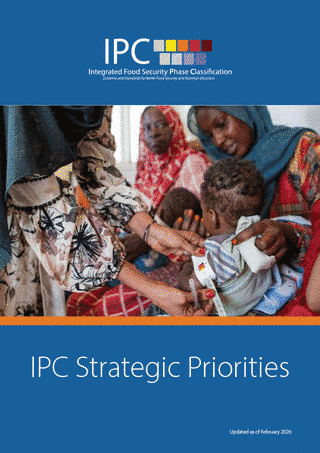
In response to emerging funding challenges, the IPC is strategically refocusing the implementation of its Global Strategic Programme to sustain and enhance its role in guiding the global response to food and nutrition crises. This renewed focus is being driven through four key priority areas:
Priority Area 1
The IPC continues to deliver high quality analyses and products for the worst food and nutrition crises
Priority Area 2
The IPC enhances its agility by leveraging innovations
Priority Area 3
The IPC maintains its role as the global reference for analyses of food and nutrition crises
Priority Area 4
The IPC Initiative strengthens strategic partnerships
For more information, please contact us on [email protected]
Join our mailing list